Five Things to Know about Medical Device Regulations in Russia in 2016

Dear fellow colleagues and group members,


As the year is coming to a close, in my final post of 2016 I would like to summarise the most remarkable and important updates that have taken place in medical device regulations in Russia and the Eurasian Union this year. Thus, here is the 2016 Russian regulatory environment at a glance:

  1. First Year of the Eurasian Union Medical Device Harmonised Regulation Model

    On January 1st 2016 the Agreement On the Common Principles and Rules of Circulation of Medical Devices in Eurasian Economic Union (EEU) officially came into force. Nevertheless, in practice, the common harmonised Eurasian system is still not working.

    During the year, the Eurasian Economic Commission (EEC) developed second-level regulations. At the end of the year, twelve out of thirteen legal documents were approved, including new approval (registration) rules for medical devices in the Eurasian Union. One of the most discussed of these second-level guidelines are the requirements for a quality management system for medical devices. Manufacturers are expected to implement mandatory quality audits for most medical device manufacturers for registration within the EEU in 2018.

    In addition to the second-level regulations in 2016, the EEC published twelve drafts of third level documents for the above mentioned agreement (e.g. list of voluntary standards, requirements for technical maintenance, recommendations for categorising borderline medical products, recommendations on the content and structure of the registration file). These have currently not been discussed.

    In November 2016, the Russian medical device trade association ― IMEDA ― together with the MedTech Europe Associations, held the Round Table “Common Market of Medical Devices: Supranational Regulation Model” in Moscow. Representatives of the EEC, together with European regulators, shared practices and discussed fundamental approaches to forming the common market of the MDs.

    According to the Agreement, today all member states of the Eurasian Union (Russia, Belarus, Kazakhstan, Armenia and Kyrgyzstan) are in a transitional period. This Agreement allows  developing a Eurasian medical device regulation model, in parallel with local medical device regulations of the member states. This transition period is set to end in 2021.

  2. Russia Continues Clear Trend of Supporting Local Medical Device Manufacturers

    In 2016, the Russian government has continued its course on import substitution, which started as a “crisis management plan” in 2014.

    In December 2016, the Russian government published Resolution #1268 (link in Russian) and significantly extended the list of certain medical devices that originate from foreign manufacturers. This was initially implemented in February 2015 in the famous Resolution #102, which allowed the rejection of applications for tenders of foreign manufacturers of medical devices on the list in case if two (or more) similar products manufactured in Russia, Belarus or Kazakhstan were proposed. However, in practice, Russian device manufacturers included in the list had to obtain a special ST-1 certificate (not a simple process), in order to prove their products belonged in a “local” category.

    Another measure intended to help develop the Russian assembly of complex medical equipment is the amendment of the Russian Tax code. This was implemented in October 2016. It provided support to Russian medical device manufacturers, exempting them from paying value added tax (VAT) for the importation of components and raw material for the manufacturing process in Russia.

    Another example is a message from the Russian Federal Antimonopoly Service published in September 2016. They raised a sensible topic for foreign manufacturers of in-vitro diagnostics (IVD) systems and started the discussion to replace “closed” IVD systems with open ones.

  3. Regulation of Implantable Medical Devices is Continuing to Develop

    Price regulations of implantable medical devices ― an initiative that started in 2015 ― had a number of updates in 2016:

    In January 2016, the Russian government published Resolution #1517 (link in Russian) titled “On state regulations of prices of medical devices included in the list”, which set the methodology for how mark-ups on such devices should be calculated.

    Since February 2016, the Russian medical device regulator Roszdravnadzor has started requesting from manufacturers of implantable medical devices and Russian authorised representatives information about weighted average prices for their products. This uses a newly created electronic database.

    In July 2016, the Russian Ministry of Health published guidelines for determining the maximum amount of wholesale mark-up on medical devices implanted in the human body.

    In August 2016, the Russian government postponed all deadlines stipulated by the Resolution No. 1517 for one year:

    -Deadline for registration of maximum sale prices of implantable devices: delayed until 15 July 2017.
    -Deadline for the establishment of the regional authorities of maximum wholesale mark-ups to the actual selling prices of the implantable medical devices: delayed until 1 September 2017.
    -Deadline for the proposals by the Russian Ministry of Health in collaboration with other concerned agencies requiring submissions of the government proposals on the agreed upon procedure of re-registration of maximum sale prices: delayed until 1 October 2017.

    In October 2016, the Russian government extended the list of medical devices that can be implanted into the human body, subject of state healthcare programmes (link in Russian). Compared to the previous version of the list, 160 new medical devices have been added (more than 360 in summary) and some old devices have been removed (devices that were not implantable, as classified according to current nomenclature).

  4. Development of Local Medical Device Regulations in Russia

    The Russian medical device registration process continues to perplex regulatory professionals due to lengthy review times and a high number of rejections. Here are some developments that took place in 2016:

    In July 2016 the Russian Ministry of Health published requirements for the technical documentation and instruction for the use (IFU) of medical devices. This clarifies the full list of the information required in the technical file and IFU for medical devices and in-vitro devices.

    In August 2016 the Russian Ministry of Health implemented a mandatory procedure for medical device manufacturers to submit amendments in the registration dossier for approved medical devices. This is in cases where technical documentation has been changed.

    In October 2016, the Russian Ministry of Health published several draft documents (link in Russian) that are intended to implement significant changes in key medical device regulations. These include simplification of the registration process for IVD products, mandatory safety reporting for high class risk medical devices, and the allowance of official consultancy from Russian medical device regulators. Currently amendments have not been approved; discussions are due to start at the beginning of 2017.

    Since August 2016 there has been vivid discussion about a possible extension of the deadline for the procedure of administrative replacements of “old” forms of the registration certificates; nevertheless as of end of the day the 29th December 2016, this suggestion has not been not approved.

  5. Development of Local Medical Device Regulations in Kazakhstan

    Compared to Russia, the medical device approval process in Kazakhstan remains quite predictable. However, several significant changes in the regulations in 2016 should be highlighted:

    Since mid-2016 the Order of Kazak Ministry of Health #421(link in Russian) came into force and introduced mandatory regular safety monitoring of medical device manufacturers and their authorised representatives in Kazakhstan. The regulator recommends submitting periodic safety reports that contain information about product incidences and corrective actions both in Kazakhstan and worldwide every three months. This should start from the date of the registration until no later than the tenth day of the month following the report period.

    Moreover, in November 2016, the Kazak government published Resolution # 634 (link in Russian) and among others changed the requirements and implemented restrictions for visual advertising of medical devices.

***

That is it for 2016; I would like to thank everyone for following, supporting and contributing to this blog and professional group. I would like to wish you a very happy holiday season and New Year filled with peace, prosperity and great achievements!

Alexey Stepanov
Alexey@medicaldevicesinrussia.com
New Set of Restrictions on the State and Municipal Procurement for Imported Medical Devices in Russia

On 7 December 2016 the Russian Government published Resolution #1268 (link in Russian) and extended a list “of certain types of medical devices originating from foreign countries subject to restrictions for state and municipal procurements in Russian Federation”. According to the Resolution, sixty two new types of medical devices have been added in the list. For such types of medical products tenders for state procurements will be closed for foreign manufacturers if at least two bids with similar medical devices from local manufacturers (Russia, Kazakhstan, Belarus or Armenia) were submitted. The adoption of Resolution represents a continuation of the course of import substitution taken by the Russian Government in 2014.

Three Things You Should Know About Medical Device Regulations in Russia, November 2016.


Dear Colleagues and Group Members,

It is the end of November, and welcome to my monthly update on the latest news on medical device regulations in Russia:


1.      Will the Deadline for Replacement of Registration Certificates be Extended?

One month is left till the deadline to complete procedure of administrative replacement of medical device registration certificates issued before 2013. According to current medical device registration rules, such registration certificates will not be valid after 1 January 2017. Replacement is free for medical device manufacturers and in practice takes 30-60 days. Based on assessment from different sources, only 20-30% of such registration certificates have so far been replaced. The possibility of extending this deadline till the end of 2021 was discussed with the regulator earlier this year by the Russian trade association IMEDA and it is quite good news that this possibility has emerged in a draft of multiple amendments to current registration rules last month. Will this draft be approved by the Russian Government, and will the deadline be extended? We will discover in December.


  1. Russia Harmonised National Standards for In Vitro Products

A number of Russian national (GOST) standards for in vitro diagnostic (IVD) (drafts were introduced last year by Russian Agency of Technical Regulation Rosstandart) came into force on 1 November 2016 and replaced older versions. Now Russian IVD standards are completely identical to relevant international ISO standards:

Russian GOST R ISO 18133-1-2015, identical to ISO 18133-1-2009, establishes general principles and specifies essential requirements for information supplied by the IVD manufacturer.

Russian GOST R ISO 18133-2-2015, identical to ISO 18133-2-2009, specifies requirements for information supplied by the manufacturer of IVD reagent calibrators, control materials and accessories for professional use, and defines the requirements for labels for outer and immediate containers and to the instructions for use.

Russian GOST R ISO 18133-3-2015, identical to ISO 18133-3-2009, specifies requirements for information supplied by the manufacturer of IVD instruments for professional use and also applies to apparatus, equipment and accessories intended to be used with it.

Russian GOST R ISO 18133-4-2015, identical to ISO 18133-4-2009, specifies requirements for information supplied by the manufacturer of IVD reagents for self-testing, calibrators and control materials and accessories intended for use with IVD medical devices for self-testing.
Russian GOST R ISO 18133-5-2015, identical to ISO 18133-5-2009, specifies requirements for information supplied by the manufacturer of IVD instruments and accessories for self-testing.

In Russia, the application of standards is voluntary for medical device manufacturers; nevertheless, following these (and other) standards is the best way to demonstrate compliance during pre-clinical testing and expert evaluation within the Russian medical device registration process.


  1. List of Regulations for State Control Activity

The Russian medical device domain is regulated at different levels, which can sometimes seem confusing and contradictory. In November, the Russian healthcare regulator Roszdravnadzor published Order # 12848 with a full list of current regulations and legal acts, containing mandatory requirements, compliance with which is assessed during government control activity by the regulator (link in Russian). Chapters ##12 and 13 are devoted to medical devices and service maintenance of medical equipment in Russia. Although this order does not contain any new legislation, it summarises in a single document an exhaustive list of existing Russian Federal Laws, Government Resolutions and other regulations for this domain. From a practical standpoint, the document can be used as a comprehensive checklist for medical device manufacturers represented in Russia to ensure compliance with local regulations.

 
Thank you for following the blog and newsletter. I am always grateful for your comments, and I encourage you to ask specific questions in the LinkedIn group.


Three Things you should Know about Medical Device Regulations in Russia, October 2016


Dear Fellow Colleagues and Group Members,

Let me deliver my selection of highlights on the status of the regulation of medical devices in Russia in October.

  1. Draft of Multiple Amendments to Russian Medical Device Regulations

In October 2016, the Russian Ministry of Health published several draft documents (link in Russian) that are intended to implement significant changes into current key medical device regulations (i.e., Federal Law 323 and Resolution #1416).  In general, the trend of proposed changes is in line with Eurasian medical device harmonization. The key suggested changes are:

  • extended validity of the “old” forms (issued before 2013) of medical device registration certificates until December 31, 2021;
  • allowance of official consultancy from Russian medical device regulator and expert organizations for applications to register medical devices;
  • simplified procedure of registration expertise of in-vitro diagnostic (IVD) products (single stage examination rather than the current two stage process);
  • implementation of mandatory annual reporting to Russian authorities of information regarding efficiency and safety data for class IIb and III medical devices within three years of registration approval;
  • implementation of mandatory regular reporting to Russian authorities of information on lot/batch numbers of class IIB and III sterile single-use medical devices and class IIB and III IVD products;
  • implementation of “180 day rule” after submission or notification of changes in the registration dossier. Medical devices that are manufactured within 180 days of date of approval of changes in the registration by the Russian regulator can be legally imported and circulated in Russia according “old” registration dossier (before changes are approved) .

Published documents are currently undergoing public and expert evaluation and they are expected to come into force by the end of the year.


  1. List of Implantable Medical Devices: New Version

On 22 October 2016, the Russian Government extended the list of medical devices that can be implanted into the human body, subject of state healthcare programmes (link in Russian). Compared to the previous version of the list, 160 new medical devices have been added and some old devices have been removed (devices that were not implantable, as classified according to current nomenclature).

Recall that, in accordance with Russian Federal Law №323-FZ, prices for implantable medical devices that are included in state programs and that are included in the list are subject to the state regulation.
The first version of the list, which included 202 medical devices, was published in 2014.
Guidelines (link in Russian) for determining the maximum wholesale mark-up that could be made to the actual selling price of medical devices implanted into the human body were approved and published in 2015.
In August 2016, the deadlines for implementation of price regulation were postponed for one year.


  1. New Fees for Amendments to the Registration Dossier

Another draft regulation regarding state fees for amendments to the registration dossier was published (link in Russian) by the Russian Ministry of Health in October 2016. Currently, amendments to the registration dossier (according to Clause 55 of Russian medical device registration rules) are free for applicants and mandatory when technical or quality characteristics of the approved medical device are changed.  The new document implements the following fees:

– amendments to the registration dossier for a medical device – 3,500 rubles (55 USD)

– procedure of expertise of amendments to the registration dossier 30,000 rubles (460 USD) – 55,000 rubles (850 USD), depending on the safety class of the device.


The objective of this blog is to make Russian and Eurasian regulations more clear. Please post your comments and questions here or on the Russian medical device regulations LinkedIn group. You can also follow me on Twitter @MedDevRus.

Three Things You Should Know about Medical Device Regulations in Russia and the Eurasian Union, September 2016


Dear colleagues and group members, please find below my selection of highlights in terms of medical device regulations in Russia, for September:


  1. State Control over Medical Devices in Russia
    In September, Roszdravnadzor (the Russian medical device approval agency) published a release about the state control over the circulation of medical devices. According to the regulator, 85% of the medical devices [on the Russian market, checked and tested in the context of state control measures] do not meet the required quality and safety requirements. Recall that today’s Russian medical device regulations require a full correspondence of all characteristics (technical specifications, model and size ranges, labelling, software versions), with the data provided in the registration dossier, and in the case of discrepancies with which this data medical product can be considered as unregistered by the regulator.
    State control over the circulation of medical devices has been implemented in Russia since 2013 and includes the possibility of revisions / audits of medical device manufacturers, distributors and clinics by Roszdravnadzor (see full regulation in Russian). Since 2015, Russia has strengthened the responsibility for violations of medical device regulations and today we can see some of the first legal practices on this.


  1. Revised Version of Requirements for Technical Files and Instructions of Use for Medical Devices
    The Russian Ministry of Health published a revised version of the draft of requirements for the technical documentation and instruction for the use (IFU) of medical devices. The document clarifies the full list of the information required in the technical file and IFU for medical devices and in-vitro devices. As you probably know by experience and based on the feedback from Roszdravnadzor, discrepancies and lack of consistency or particular information regarding these documents are the most common reasons in registration delays today.
    An interesting innovation for Russia is that the draft regulation allows a shorter version of instructions for the use for medical devices of the I and IIA class (on the condition that such medical devices can be safely used). According to the document, it is also allowed to distribute electronic forms of instructions for use (on the website or on the screen of the medical devices)—in this case, the manufacturer must ensure that the consumer is informed about how to have access to the up to date version and about how to receive their paper version.
    #
  2. Tax Exemption for Foreign Medical Device Components
    A number of amendments to the Russian Tax Code, exempting Russian medical device manufacturers from paying value added tax (VAT) for importing components and raw material for the medical device manufacturer process in Russia, will come into force on the 1st of October 2016. Until that day, Russian medical device manufacturers are required to pay 18% VAT on any imported components for their products, which, in some cases, poses significant restrictions and impacts on the cost of the manufacturing process. New amendments grant VAT exemptions in situations whereas the imported medical device components or the raw materials have no Russian equivalents and in those cases when their intention for manufacturing a medical device is proven. According to experts, the amendments will help to develop the Russian assembly of complex medical equipment, but their implementation in practice may take some time.

Three Things You Should Know about Medical Device Regulation in Russia and Eurasian Union. August 2016


Dear Colleagues,

While there was not visible progress in the development of a harmonized Eurasian medical device regulation model in August, there were some quite important regulatory changes in local medical device regulations in Russia and Kazakhstan.
As usual, here are my three highlights for regulatory professionals interested in what is going on in our region:


  1. Russia: Price Regulation for Implantable Devices Postponed

On 1 August 2016, the Russian Government amended the following decree adopted at the end of last year: “On state regulation of prices for medical products included in the list of medical devices implanted in the human body…” (Resolution #1517). The corresponding document, Resolution #735, has been published on the Russian legal information portal (link in Russian). According to these amendments, the deadlines for providing documents for medical device manufacturers have been postponed for one year:
-Deadline for registration of maximum sale prices of implantable devices: until 15 July 2017.
-Deadline for the establishment of the regional authorities of maximum wholesale markups to the actual selling prices of the implantable medical devices: until 1 September 2017.
-Deadline for the proposals by Russian Ministry of Health in collaboration with other concerned agencies requiring submissions of the government proposals on the agreed upon procedure of re-registration of maximum sale prices: until 1 October 2017.


  1. Russia: Deadlines for the Procedure of Administrative Replacement of Registration Certificates

There are less than five months left until the deadline set by the Russian government in 2012 for the procedure of administrative replacement of “old” registration certificates for medical devices that were issued before 2013. According to Roszdravnadzor (the Russian medical device regulator), less than 9.2 thousand files for replacement have been submitted to authorities by medical device manufacturers since 2013 (out of the 37.5 thousand registration certificates which require replacement). Some experts say that this situation can lead to a problem where a significant number of medical devices may lose their approval in the Russian market from January 2017.
In the same time, the new Eurasian medical device regulation model requires medical device manufacturers to re-register their products by the end of 2021, according to the new Eurasian registration procedure.

Considering this, IMEDA (International Medical Device Manufacturers Association) sent a petition to the Ministry of Health of Russia with the suggestion to extend deadlines for the replacement of “old” registration certificates until the end of 2021.

Later in August, Roszdravnadzor issued a news release pointing out that the procedure for the replacement of registration certificates takes 30 days, and that today “medical device manufacturers have enough time to get new registration certificates.” determining that the statements about potential problems on the medical device market in 2017 stemming from bureaucratic reasons were “baseless.”


  1. Post-market Surveillance Requirements for Medical Devices in Kazakhstan

Kazak medical device regulator, the National Center of Medicines, Medical Devices and Medical Equipment, clarified in August 2016 that according to the Order MZSR RK #421(link in Russian) regular safety monitoring is mandatory for medical device manufacturers and their authorized representatives (holders of registration certificates with an unlimited validity term in the Republic of Kazakhstan). The regulator recommends submitting periodic safety reports every three months starting from the date of the registration until no later than the tenth day of the month following the report period. The safety report must contain information about product incidences both in Kazakhstan and worldwide and  information about corrective actions. The form for the report is provided in Russian on the website of the regulator.

The objective of my blog is to help regulatory professionals understand the Russian medical device regulatory environment. I would like to remind that you can follow my updates concerning Russian medical device regulations on Twitter @MedDevRus, or receive them directly via email using the “Follow” button on the toolbar of this page.

Three Things You Should Know about Medical Device Regulations in Russia and Eurasian Union, July 2016

Dear Colleagues,

It is the end of July and welcome to my monthly update, in which I share the latest news and updates on medical device regulations in Russia and countries of the Eurasian Economic Union (EEU).


  1. Rules of Medical Device Registration in Eurasian Union have been published.

    On 12 July 2016, the Eurasian Economic Commission published the final and approved version of the Eurasian Medical Device Registration Rules (link in Russian) – one of the most long-awaited regulations of the new EEU Medical Device Harmonized model. As was the case previously, the new registration process for medical devices is based on local pre-clinical testing in an accredited laboratory, clinical trials in one of the member states of the Eurasian Union, and a 60-day expertise phase (assessment) by a governmental expert organization (more details).
    In parallel with these new rules, on 5 July 2016, the Russian Ministry of Health published a draft regulation (link in Russian) aimed at amending the Russian tax code and introducing state fees for registration, expert assessment, amendments and renewals of registration certificates under the new Eurasian Harmonized Medical Device registration procedure.
    By the end of July 2016, eleven of the thirteen final editions of second-level regulations will have been published. Experts at the Eurasian Commission expect the new medical device regulation model to be fully operational by the end of the year.

  2. Russia: Medical Device Trade Associations Warn about Potential Collapse of State Procurement of Implantable Devices.

    On 5 July 2016, the Russian Ministry of Health published  guidelines for determining the maximum amount of wholesale mark-up, to the actual selling price, on medical devices implanted in the human body (link in Russian).
    According to the published document, the maximum size of the wholesale mark-up established by Russian regional authorities takes into account the costs associated with the production of these medical devices. Justification for these production costs must be provided by the medical device manufacturer or its authorized representative. As an example, the calculation of the maximum wholesale mark-up, provided in the published guidelines, is from 1 to 7 per cent or 350 – 10,000 Russian rubles, depending on actual selling price.
    At this same time, leading regional and global medical device trade associations together have called on the Russian Government to postpone implementation of price regulation for implantable devices to January 2018, intensify cooperation between the industry and the regulator, and warn about the potential freezing of state procurement of implantable medical devices in Russia.
  3. Federal Law on “Biomedical Cell Products”
    At the end of June 2016, the Russian Federal Law “On Biomedical Cell Products” #180 FZ (Link in Russian) was signed by the Russian President and officially published. This federal law is a basic document which implements the legal terms of biomedical cell products and regulates their research and development with the related donation of biological material, pre-clinical action, clinical studies, registration, circulation, import and export and transportation of such products. The document will come into force on 1 January 2017.

The objective of this blog is to help regulatory professionals better understand the Russian medical device regulatory system. Please post your comments and questions here or in the Russian medical device regulations LinkedIn group.

Three Things You Should Know about Medical Device Regulations in Russia and the Eurasian Economic Union, June 2016


Dear colleagues and group members,

Traditionally, summertime is not a very hot season for regulatory updates, so I am glad to share these three important highlights for medical devices in Russia and the Eurasian Economic Union (EEU):


  1. Update on Eurasian Medical Device Regulatory Model

On 2 June 2016 the Eurasian Commission published final versions of two second-level pieces of legislation for the harmonized Eurasian medical device regulatory system:

  1. Rules for Biocompatibility Testing of Medical Devices (link in Russian)
  2. List of Medical Devices with Measuring Function (link in Russian)

As at the end of June 2016, ten out of thirteen final versions of the Eurasian medical device regulations have been published. The final versions of two of the most crucial documents – “Eurasian Medical Device Registration Rules” and “Guidance for a Quality Management System for Medical Device Manufacturers” are still under discussion between member states and are expected within the near future.

Recall that although the Agreement on Common Principles and Rules of Circulation of Medical Devices formally came into force at the beginning of 2016, the new system is still not working.


  1. Discussions around price registration for medical devices

Some implantable medical devices (i.e. intended for fixation, delivery or extraction of implants or preparation for implantation procedure) may be removed from the “List of Implantable Medical Devices for Medical Aid Provided to Citizens under the Programme of State Guarantees of Free Medical Care” and exempted from the mandatory requirement of price registration. In June the draft law (link in Russian) was prepared and sent to the Russian parliament for discussion and approval.

In this context it should be recalled that 15 July 2016 is the deadline set by the Russian medical device regulator Roszdravnadzor for manufacturers of implantable devices to provide the regulator with information about the prices of their products.


  1. Clear identification of the medical device is critical for proper registration

In June, the Russian press loudly reported a story illustrating an example from current Russian medical device regulatory practice. Because of revealed discrepancies in the Russian registration certificate, Roszdravnadzor deemed the medical devices as non-[properly]-registered, and after that banned products of the UK manufacturer and one of the market leaders in its segment (read more in English).

Over the last few years Roszdravnadzor has increased controls on medical devices and requires notifying about any changes in product name or technical parameters of a registered device to ensure consistency between the registration certificate and the previously submitted registration file. Moreover, in contrast to previous registration rules, which allowed common “family” or “umbrella” registrations, clear identification of the brand name and model of the medical device is mandatory for proper medical device registration.

If you like my updates about Russian medical device regulations you can follow me on twitter @MedDevRus or get them directly via e-mail using the “Follow” button on the toolbar of this page.

Three Things You Should Know about Medical Device Regulations in Russia and the Eurasian Economic Union, May 2016

Dear colleagues and group members,

Welcome to my monthly update on medical device regulations in Russia and countries of the Eurasian Economic Union (EEU). Here are my three highlights for May 2016:


  1. Development of the Eurasian Medical Device Regulations

In May 2016, the Eurasian commission published final approved versions of five second-level regulations (which were previously available as drafts) for the Agreement on Common Principles and Rules of Circulation of Medical Devices in the Eurasian Economic Union (EEU):

  • Essential principles and rules on the safety and effectiveness of medical devices (link in Russian) – this document was drawn up on the basis of similar GHTF guidance and provides general and fundamental design and manufacturing requirements on the safety, quality and performance of medical devices (MD) and in-vitro medical devices (IVD). In addition, this document provides common labelling requirements for MD and IVD within the Eurasian Economic Union
  • Rules on conducting technical testing for medical devices (link in Russian) and Rules on conducting clinical trials (link in Russian) provide guidance on conducting pre-submission testing and trials. Good news for IVD manufacturers – in contrast to the current Russian approval process, only clinical trials will be needed in the EEU (skipping the technical tests). Not so good news for implantable devices – full-scale clinical trials with patients’ involvement will be mandatory for their approval
  • Resolution on the EEU medical device mark (link in Russian) – this document provides detailed descriptions of new EAC (EEU) medical device symbols and procedures of EAC-marking for medical devices approved under the new harmonised approval process
  • Resolution on the formation and maintenance of the common medical devices information system (link in Russian), which describes procedures for the common Eurasian database of approved medical devices, clinical centres and laboratories accredited to conduct trials/testing and information on medical devices’ adverse reactions and safety field actions within the EEU.

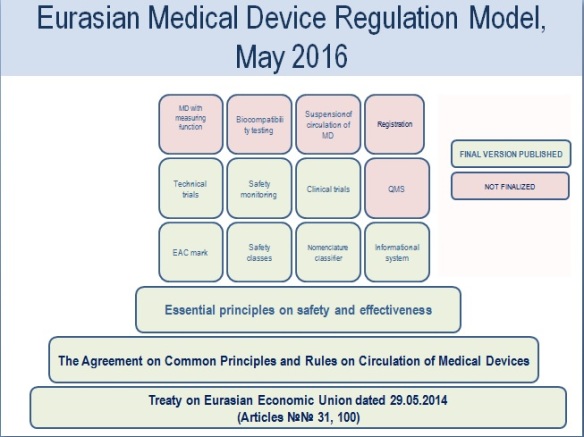
In these ways, today the full Eurasian medical device regulatory model can be vizualized like this:
EEU 201605

Although currently the new EEU procedures do not work in practice, according to the Eurasian commission, a full-scale launch of the new harmonised system is expected in 2016.


  1. The Russian Ministry of Health is considering an extended list of Implantable Medical Devices
    The Russian Ministry of Health is preparing an extension of the “List of Implantable Medical Devices for Medical Aid Provided to Citizens under the Programme of State Guarantees of Free Medical Care“. According to information published in May 2016 (link in Russian), the Russian regulator reviewed 671 applications from medical device manufacturers and medical institutions, with positive decisions made on the majority of them.

    In this context, it should be recalled that the last version of the list (with 207 items) was published in December 2014. According to the Russian Ministry of Health, companies producing Implantable Medical Devices not included in the list will not able to participate in national healthcare programmes from 2017. According to current procedures, applications for inclusion in the list can be submitted to the Ministry of Health by 1st March each year.


  1. New Version of Guidelines for Expertise in Medical Devices
    A draft of new guidelines on the expertise in medical devices for procedures of registration was published in May 2016 (link in Russian). This document contains detailed descriptions of the expertise procedure, requirements on documentation format for registration and testing files, and unifies these requirements from two expert organisations. The document will replace the previous version of these guidelines (link in Russian) published in November 2013 and will be expected to come into force formally in the near future.

Thank you for following the blog and newsletter. I am always grateful for your comments and encourage you to ask specific questions in the LinkedIn group.

Three Things You Should Know about the Regulation of Medical Devices in Russia, April 2016

Dear colleagues and group members,

Let me share the latest news and updates on medical device regulations in Russia CIS and countries of the Eurasian Economic Union (EEU). Here are my three highlights from April 2016.


  1. Prolongation of the Transitional Period in Ukraine.

At the beginning of April 2016, the Ukrainian government published the text of Decree # 240 (link in Ukrainian), which extended by one year (until 1 July 2017) the transitional period for medical devices registered in the country before July 2015 in accordance with the “old” medical device approval system. The document also stipulates that, if a registered medical product has a valid registration certificate that expires before the 1st July 2017, that product must pass a new conformity assessment procedure, either after the expiry date of this certificate or during its validity period (the former option was not previously possible due to a gap in the law). At the moment, more than ten notification bodies operate in Ukraine under the new procedure that came into force in July 2015.


  1. Roszdravnadzor on Price Regulation for Implants

In April 2016, Roszdravnadzor (the Russian medical device regulator) finished collecting information from medical device manufacturers on prices for implantable medical devices.
As announced in Roszdravnadzor’s seminar on the 27th April 2016, information on the prices of implantable medical devices has been provided to the regulator by 68 Russian companies. On the basis of this information, “weighted-average” prices will be calculated and published by for each type of implant in the coming weeks. The Russian medical device agency highlighted that, according to Resolution #1517 (link in Russian), all applications for the registration of prices must be submitted by manufacturers before the 15th July 2016 (but not before the “weighted-average” prices have been published).

It should be noted that, according to Resolution #1517, submitted prices cannot exceed the published “weighted-average” prices, and implantable devices with unregistered prices will not be included in government healthcare programmes from 2017 onwards.

At the same time, Roszdravnadzor provided information about the forthcoming expansion of the list of implantable medical devices subject to national healthcare programmes.


  1. Amendments to Resolution #102 on Access Restrictions for Certain Types of Medical Products.

On the 22nd April 2016, the Russian government published Resolution №337, which gave details of a number of amendments and refinements to Resolution №102 “On Establishing Access Restrictions for Certain Types of Foreign-Made Medical Products”. In accordance with Resolution №102, which was published in February 2015, Russian customers have to reject an application for the state procurement of medical devices made by foreign manufacturers from the restriction list (with the exception of countries in the Eurasian Economic Union) if at least two bids were filed for participation in the tender by local manufacturers. The new regulations set a prohibition on inclusion in the same bid in the tender medical devices included in the restriction list and is not included in it. In addition to this, the new resolution prohibits changes being made to the manufacturer or country of origin of medical devices during contract execution.


The objective of this blog is to make Russian and Eurasian regulations clearer. Please post your comments and questions here or on the Russian medical device regulations LinkedIn group. You can also follow me on twitter @MedDevRus.