
Three Things You Should Know about Medical Device Regulatory Changes in Russia in 2017

Dear fellow colleagues,

Welcome to my end-of-year update. Today I want to share my vision and briefly summarise the most important changes, news, and trends in the Russian and developing Eurasian medical device regulation landscapes in 2017.


  1. Eurasian Medical Device Regulations – Summary of Changes, 2017

“In 2017, the formation of medicinal device legislation within the framework of the Eurasian Economic Union (EAEU) has been completed …. This is the most significant event of the year.” This was the message given by the head of Russian medical device regulator Roszdravnadzor at the conference in the Russian healthcare week in early December 2017.

We can see quite significant development of the EAEU medical device regulation system throughout the year of 2017. In March 2017, the registration and expertise fees for EAEU registration were published. Since May, twelve out of thirteen second-level regulations fully came into force and were gathered and published on the website of Roszdravnadzor.

The last and the most long-awaited document — EAEU requirements for the implementation of a quality management system for medical device manufacturers — was approved in November 2017.

By the end of the year, Russian laboratories started obtaining accreditation for conducting medical device testing according to EAEU medical device regulations. For the end of December 2017, there is information about three laboratories accredited for technical testing, one laboratory for toxicology/biocompatibility testing, and one centre for clinical trials on the website of the Russian medical device regulator. During several seminars on EAEU registration requirements, representatives of the laboratory confirmed the “green light” for the start of testing for registration.

This green light was also confirmed by EAEU member states; for example, the Belorussian Ministry of Health published information and documents for the submission of a registration file according to the Eurasian procedure. First companies report on the start of the EAEU registration process. However, for the end December 2017, there is no information on the possibility of submitting a registration file for EAEU evaluation in Russia.

It should be also recalled, that the end of the transition period introduced  in the Article 11 of the  Eurasian Agreement of Common Rules for Circulation of Medical Devices was set as 31 December 2021, and the requirement is that the re-registration (i.e. the full EAEU registration procedure) of all medical products in the EAEU market should be within less than four years. So far, no changes in this deadline nor information about the possibility of a simplified re-registration procedure have been formally announced.


  1. Changes in Russian Medical Device Regulations – Summary of Changes, 2017

Medical device approval in Russia still remains a very complex, time-and-resource consuming process. However, in parallel with the development of Eurasian medical device regulation, there were several significant positive changes in 2017.
Order #11N, containing a full list of requirements for the technical file and instructions (IFU) for the registration of medical devices and in-vitro diagnostics (IVD) in Russia, was published in March 2017 by the Russian Ministry of Health.

A pre-submission consultancy service was opened in 2017 by Russian regulatory expert centres involved in the registration process, with the aim of creating opportunities for manufacturers to receive formal feedback on specific aspects of the Russian regulatory process for their products from a competent authority prior to starting registration or submitting a medical device application. Until 2017, Russian legislation did not allow such forms of direct communication between manufacturers and registration experts.

An initiative for the simplification of the registration process for IVD has been discussed since the end of 2016. The draft regulation suggesting a one-step expert registration assessment for IVDs instead of the current two-step pathway was published at the beginning of August 2017, but at the end of the day of 27 December it has not yet been finally approved.

Russian medical device regulator Roszdravnadzor continues on a strong course to strengthen control of already approved medical devices in the market. Thus, the regulator announced there were more than 975 published “warning letters” about devices revealed to be in circulation that violated current legislation and more than one million units of non-registered or counterfeited devices banned and withdrawn from the market in the last year. It should be recalled that even a minor discrepancy in the product compared with the information submitted and approved in the registration file may be considered by the regulator as a violation and a reason for the ban.

  1. Continued Course on Restrictions for Foreign Medical Device Manufacturers

Restrictions on the admission of foreign medical products is the initiative started by the Russian government in February 2015, when Resolution #102 was introduced as a measure supporting the “import replacement” programme and “promoting the development of domestic manufacturing of medical devices”. As can be observed, the Russian government has continued on this course over the past year.

In August 2017, the Russian government adopted resolutions #967 and #968, aimed at creating modern competitive production of medical polyvinyl chloride (PVC) consumables in Russia, and  significantly extended the list of restricted medical devices. In particular, it introduced a separate list for six groups of consumables made of PVC and adopted a new approach to public procurement of these products.

In December 2017, a new decree, #1469, which indicated a temporary preference for Russian producers of coronary stents and catheters, established new restrictions on the admission of government purchases of these cardiac surgery products originating from foreign countries if at least one application from a Russian supplier is received. The restriction is effective until 1 July 2018.

At the end of the year, a new draft document was published by the Russian Ministry of Industry and Trade aimed at further expanding the restrictive list. The document contains twelve new types of products proposed for further restrictions, including test strips, dental composite filling materials, and endoprostheses.

******

I would like to take this opportunity to thank everyone for following my blog,  professional group and Twitter updates and wish all a very happy festive season and much success with Russian projects in 2018! Next year, I am going to continue my updates with the purpose of trying to make challenging Russian medical device regulatory system more clear for regulatory professionals.
I will be very glad of your comments, questions, and ideas!
Three Things You Should Know about Medical Device Regulations in Russia, November 2017

Dear colleagues and group members,

Welcome to my monthly newsletter with the most important regulatory updates on medical devices in Russia for November 2017.

  1. Russian medical device expert organisations are starting pre-submission consultancy
    In November 2017, both Russian expert organisations involved in the registration process announced the start of pre-submission consultations for medical device manufacturers. The expert organisations published information on consultancy procedures, application forms, contracts, information on prices, and required and recommended documents on their websites:
    – Consultations from VNIIMT (ВНИИМТ) expert organization – link in Russian;
    – Consultations from CMIKEE (ЦМИКЭЭ) expert organization – link in Russian;

    According to Roszdravnadzor Regulation 6478 (link in Russian) published in July and enforced in September 2017, the scope of the consultations are: development of a medical device and necessary documentation and testing for registration and re-registration for particular devices, specific aspects of the Russian registration process and requirements, classification of medical devices, and determination if a product meets the definition of a medical device, according to Russian regulations.

  2. Evolution of restrictions on polyvinyl chloride consumables
    On 1 November 2017, the Russian Ministry of Health published a letter (link in Russian) with information on weighted average prices for disposable medical devices from the government list of foreign disposables made from polyvinyl chloride (PVC) plastics, whose admission to public procurement was restricted by Resolution # 968.
    It should be recalled that Resolution No. 967 (link in Russian) and Resolution No. 968 (link in Russian) came into force in August 2017, and extended the list of medical products restricted from participation in state procurements, (link to up-to-date version in Russian) with particular reference to medical devices containing PVC implementing criteria for its manufacturers, and the new scheme of state procurement for such products.
    The national register for manufacturers of PVC consumables that met the criteria is published by the Russian Ministry of Industry and Trade and at the end of November contains one company.

    3. Medical software in telemedicine technologies

    On 3 November 2017, the Russian Ministry of Health published draft regulations on providing medical care using telemedicine technologies (link in Russian). Amongst other matters, the document contains a requirement for mandatory registration of special medical software that is ‘designed for the prevention, diagnosis, treatment and medical rehabilitation of diseases, monitoring the state of the human body and used as a part of information systems’ as a medical device.

    It should be noted that, the Russian medical device regulator Roszdravnadzor has emphasised several times during the past years that medical software should be considered a type of medical device and must therefore pass the mandatory registration process

Three Things You Should Know about Medical Device Regulations in Russia, September 2017

Dear Colleagues and Group Members,

This is a monthly update with a selection of the latest news on medical device regulation changes across Russia and the Eurasian Union.


  1. Development of Eurasian Medical Device Regulations


On 4 September 2017, the Eurasian Economic Commission published Recommendation No. 17, (link in Russian) ‘On the list of voluntary national standards that […] ensure conformity of a medical device with the Eurasian Essential Requirements for the Safety and Efficiency of Medical Devices’. The document harmonises existing national standards (155 voluntary standards for different types of medical devices and 43 standards for in-vitro devices) of the member states of the Eurasian Union and correlates them with the relevant requirements of the Essential Checklist.

In addition, earlier in September a number of drafts concerning medical device classifiers were published by the Eurasian Commission:

  • classifier of changes in the registration dossier of a medical device (link in Russian)
  • classifier of documents in the registration dossier of a medical device (link in Russian)
  • classifier of medical device area of usage (link in Russian).
    Usage of codes of the above classifiers are expected to be mandatory across several steps of medical device turnover in the Eurasian Union

At the same time, Roszdravnadzor (the Russian medical device regulator) created on its website the section ‘Registration of medical devices within the framework of the Eurasian Economic Union’, in which all Eurasian medical device regulations that came into force at that time were summarised.

Despite all published regulations, as of the end of September 2017, applications on Eurasian medical device registration process are still not working.


  1. Russian Ministry of Finance Clarified Rules for Medical Device Tax Exemptions

On 11 September 2017, the Ministry of Finance of the Russian Federation published a letter # СД-4-3/1794 (link in Russian) in which it recalled the rules for exemption from value added tax (VAT) when selling medical devices in Russia.

The regulator also confirmed the same VAT exemption for both ‘new’ and ‘old’ registration documents for the period 1 January 2017 to 30 June 2017 (i.e. the period before the amendment of the Russian tax code).

In this context it should be recalled that in February 2017, the Russian government published Resolution #160 (link in Russian) and extended to 1 January 2021 the deadline for the administrative replacement of the ‘old’ Russian medical device registration certificates.


  1. Medical Devices Incorporating a Medicinal Substance – Difficulties in Registration in Russia*

The registration of borderline products and medical devices with ancillary medicinal (pharmaceutical) substances is now one of the most pressing regulatory problems in Russia.

Resolution (Order) #11 N of the Russian Ministry of Health (link in Russian), which came into force in March 2017, requires the mandatory registration of all such chemical or pharmaceutical components as pharmaceutical substances in the Russian Federation.

On 25 September 2017, 38 manufacturers and distributors of medical devices in Russia submitted a collective letter to Russian medical device regulator Roszdravnadzor, the Ministry of Health, and the Ministry of Industry and Trade, in which they drew attention to serious difficulties with, and in some cases the impossibility of, state registration of whole groups of medical devices (for example, dental cements and adhesives, drug-eluting stents, cosmetic fillers…) under new requirements.

The petition contains an analysis of the current regulations of borderline products and medical devices with ancillary medicinal (pharmaceutical) substances, as well as a request to regulators to clarify their position on this issue and correct contradictions in legislation. The issue has received wide coverage in the Russian media.


*****

* I would like to express my thanks to Medrelic – a Russian consulting company for the registration and certification of medical devices – for kindly providing material and sharing expertise on issues regarding the registration of medical devices incorporating pharmaceutical substances.

Russia Opens Pre-submission Consultancy for Medical Device Manufacturers


On 10 September 2017, the order #6478 (link in Russian) came into force.
This order introduces pre-submission consultations from Russian regulatory expert centers involved in the registration process to medical device manufacturers for requesting feedback prior to start registration, local testing or submitting a medical device application to Roszdravnadzor (Russian medical device regulator) as far as discussing specific aspects of the Russian regulatory process and requirements (e.g. medical device classifications and designation of a product to medical device regulations).

Until now, Russian law did not allow such forms of consultancy, and direct communication between manufacturers and authorities on any specific question was formally prohibited.

Consultations will be paid for medical device manufacturers but not mandatory for obtaining approval.

Three Things You Should Know about Medical Device Regulations in Russia, August 2017


Dear Colleagues and Group Members,

Here is my monthly newsletter with the most important regulatory updates on medical devices in Russia for August 2017.


  1. Restrictions for Plastic Consumables

In August 2017, the Russian government introduced two important regulations affecting public procurements of a broad range of medical devices made from polyvinyl chloride (PVC) plastics.
According to Resolution # 967 (link in Russian), which came into force on 25 August 2017, suppliers to the Russian market of medical devices manufactured with PVC will from now on be determined from the list of organizations implementing projects to localize the production of medical products in Russia in 2017–2024. The Resolution also sets rules for selecting such suppliers. In particular, organizations must have the right to technical documentation for the respective devices for a period of not less than ten years, and use technologies and raw materials developed within the framework of the Russian “Development of the pharmaceutical and medical industry” programme for 2013–2020.
At the same time, another adopted Resolution # 968 (link in Russian) includes six groups of disposables made of PVC plastics in the list of medical products for which state procurement from foreign manufacturers will be limited  (according to the Resolution #102 dated from February 2015).


  1. Draft Resolution on Changes to Russian Medical Device Registration Rules

The draft Resolution on Amendments to State Registration of Medical Devices is another important document which was published (link to the draft in Russian) at the beginning of August 2017. The main change proposed in the draft is a simplification of registration of in-vitro diagnostics (IVD): by analogy with the simplification of procedures for I class devices introduced in 2015, the document proposes one-step expert assessment (so called expertise) for registration instead of the current two-step pathway. Another possible innovation proposed in the draft is a significant change of procedure in the amendment of registration certificates and registration dossiers (product re-registration): it proposes a list of changes which do not require expert assessment for re-registration, and establishes a timeline for such re-registration as 15 working days.
As of the end of August 2017, a draft of the document is undergoing regulatory impact assessment by Russian authorities.
 

  1. Adopted Changes in Alcohol Regulations will affect some Medical Devices

On 29 July 2017, Russian authorities adopted Federal Law № 278-FZ (link in Russian), which changes measures to control the turnover/distribution of pharmaceutical substances of ethyl alcohol, including in the production of alcohol-containing medical devices. The regulation defines “alcohol-containing medical device” as a medical device in a liquid form, containing a pharmaceutical substance of ethyl alcohol (ethanol). The published law requires, in particular, additional registration and declaration procedures for legal entities that carry out the manufacturing and turnover/distribution of alcohol-containing medical devices in Russia. According to the regulation, lists of exceptions are established, i.e. “alcohol-containing medical devices” not covered by this regulation. These changes will become operative from 1 January 2018.


Thank you for following this blog, whose objective is to make Russian and Eurasian medical device regulations clearer. You can receive updates directly to your e-mail via the “Follow” button on the toolbar.

Russia Implemented New Scheme for Public Procurement of Plastic Consumables

Intravenous-Product-Packaging.jpgOn 17 August 2017, the Russian government published the resolution #968 (link in Russian) and introduced a new scheme for public procurement of consumables medical devices made from polyvinyl chloride plastics on the Russian market. Published document  seriously amends the  previously adopted Resolution No. 102 of the Russian Government dated 5 February 2015 “On Establishing Access Restrictions for Certain Types of Foreign-Made Medical Products to Procurements for State and Municipal Needs” completing  it with “the list #2″ of medical devices  made from polyvinyl chloride.
List #2 contains six groups with 86 types of plastic consumables classified using Russian nomenclature system: blood storage  products, consumables for plasmapheresis,  pulmonary ventilation and heart-lung machines, urine/colostomy bags.

According to the document, the preference in public procurement of products from the list #2 henceforward will be given to those companies that invest in specialized production on the territory of Russia according to previously published criteria (link in Russian).

The document will come effective on 25 August 2017.

Extension of the List of Implants for National Healthcare Programs

On 31 July 2017 the Russian government published the Resolution #1587-r (link in Russian) and extended the list of implantable medical devices for national free healthcare aid programs. The existing version of the list with 359 types of implantable medical devices (link in Russian) have been completed by new 23 types of devices  most of which are intended for preparation for surgical interventions as well as delivery, fixation and extraction of implants.

Initially, the list was implemented in the end of 2014, and for today, according to Russian Federal Law 323-FZ, presence of a product in the list is a mandatory requirement for  its participation in national healthcare programs. Products in the list are subject of maximum sales prices and maximum mark-ups regulation in Russia.

Three Things You Should Know about Medical Device Regulations in Russia and the Eurasian Union, May 2017


Dear colleagues and group members,


Here is May’s monthly newsletter, showing a selection of medical devices and regulatory highlights for Russia and the Eurasian Union.


  1. Developments in Eurasian Economic Union (EAEU) Medical Device Regulation

“On May 6, 2017, the main regulation acts of the EAEU, ensuring the functioning of the common markets for medicines and medicines, are coming into force” –this statement was made  by the Minister of the Eurasian Economic Commission, Valery Koreshkov, at the very beginning of May. Thus, ten days after the ratification of the protocol on Armenia’s accession by the Kyrgyz Republic, most of the ‘‘second level’’ documents regulating the circulation of medical devices in the single market of the Eurasian Economic Union came into operation. The thirteenth and last ‘‘second level’’ document on the requirements for the quality management system (QMS) has not yet been adopted or entered into force. However, this is not likely to be an obstacle to the launch of a single medical device market.

Later, on 24 May 2017, the Eurasian Commission published the first draft of “third-level” regulations – recommendations on a list of applicable standards to ensure compliance with essential principles of safety and efficacy of medical devices in the EAEU (link in Russian). The document contains a list of 43 standards (mostly Russian GOSTs and Belorussian STBs) which may be voluntarily used by manufacturers and testing laboratories of member states to demonstrate conformity with new Eurasian medical device regulations. The Eurasian Commission recommends that member states implement the list gradually, within six months from the day of its official publication.

In addition to this, Russian healthcare regulator Roszdravnadzor announced an upcoming one day seminar and webcast on the registration of medical devices in accordance with the changes in the legislation of the EAEC. This will take place in Moscow on 8 June 2017. The agenda of the seminar also covers topics relating to clinical trials, vigilance requirements and implementation quality management systems according to EAEU requirements.

  1. Medical Device Nomenclature in Kazakhstan

On 22 May 2017, the Ministry of Health of Kazakhstan approved new nomenclature of medical devices harmonised with the Global Medical Device Nomenclature (GMDN) together with the Methodological Guidelines for the Formation and Maintenance of the Nomenclature of Medical Devices of the Republic of Kazakhstan. Nomenclature of medical devices may be used for registration, traceability, public procurement and post-registration control for medical devices. New medical device nomenclature is available online (link in Russian) and contains a list of medical devices, including their names, relevant codes and descriptions of their types, as well as classification characteristics used for search and classification.

  1. Russian Regulator Updates Checklist for Control Inspections

At the end of April 2017, Russian healthcare regulator Roszdravnadzor published its order #4043 (link in Russian) and updated the “list of regulations containing mandatory requirements, the observance of which is assessed in the course of state control”. The abovementioned list replaced the previous version published by the regulator in November 2016 (Order #12848). Section three of the published list is devoted to state control of medical devices and summarises the full list of applicable regulations which is assessed by Roszdravnadzor during audits and inspections of manufacturers of medical devices and medical facilities in Russia.


***

The objective of this blog is to clarify Russian and Eurasian regulations. Please post your comments and questions here or on the Russian medical device regulations LinkedIn group. You can also follow me on Twitter @MedDevRus.

Three Things You Should Know about Medical Device Regulations in Russia and the Eurasian Union, April 2017

Dear colleagues and group members,

Welcome to my usual update on medical device regulations in Russia and countries of the Eurasian Economic Union (EAEU). Here are my three highlights for April 2017:

  1. Lifting Political Barriers for the Launch of Eurasian Economic Union Medical Device Regulations

    On 5 April 2017, the Kyrgyz Republic endorsed a law “On Ratification of the Protocol on Accession of the Republic of Armenia to the Agreement on Common Principles and Rules for the circulation of medical products within the EAEU”. According to the provisions of the Protocol, Armenia officially joins the above Agreement. Until this date, ratification of this Protocol was one of the main political factors hampering the full launch of the unified medical device market and regulatory model for EAEU countries. The law entered into force ten days after the day of its official publication.

    In this way all the obstacles to beginning the work of a unified pharmaceutical and medical device market have been lifted and all the second-level EAEU medical device regulations (except the quality management system requirements which are not released by the Eurasian Commission yet) are de jure coming into force for all EAEU member states.

    It will be recalled that in recent months official fees for the registration of medical devices according to the new Eurasian procedure were published in Russia, Belarus and Armenia.


  1. Statistics on Medical Device Registration in Russia

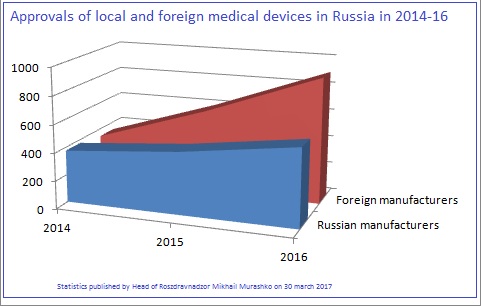
    At the end of March 2017, Russian medical device regulator Roszdravnadzor published statistics on registration of medical devices for the year 2016. It was reported that 1,465 new medical devices had been approved (which is around 40% higher than the year before) – among them 559 (38%) products manufactured in Russia and 906 (62%) by foreign manufacturers.

    Statistics on MD 2016.jpg
    According to the report, the number of registration refusals decreased by around 9% compared to the year before: the regulator reports 477 refusals with a similar ratio: 163 (34%) for local and 314 (66%) for foreign manufacturers. Roszdravnadzor evaluates the total number of registration refusals for the year as 15.2%.


  1. Quality Management System Inspections in Kazakhstan

    On 3 April 2017 the Kazakh medical device regulator (the National Center for Expertise) published a memo (link in Russian) for medical device and pharmaceutical manufacturers clarifying the rules for organising quality management system (QMS) inspection for registration of medical devices and pharmaceutical products. According to the document, for medical device manufacturers QMS inspection is mandatory if a legal manufacturer has never been registered in Kazakhstan before or manufacturing facilities have not been registered in Kazakhstan before, or in cases when conducting an analytical examination is impossible due to the lack or high cost of product samples. The regulator reminds us that the decision about inspection can be taken at any time during the examination. The inspection is carried out within 2-5 working days on one manufacturing site. Valid ISO standard certification of the manufacturer is a necessary condition for the inspection. The Kazak regulator highlights that the manufacturer should: organise the inspection within 30 days after receiving official notification; pay all costs associated with the procedure; and provide translation of necessary information into Russian.


Thank you for following this blog! My objective here is to make Russian and Eurasian medical device regulations clearer. You can also follow my updates on Twitter @MedDevRus

Three Things You Should Know about Medical Device Regulations in Russia and the Eurasian Union, March 2017.


Dear Colleagues and Group Members,

Welcome to my monthly update on the latest news on medical device regulations in Russia and the Eurasian Economic Union. Here are three of the most important updates for March 2017:


  1. Russia Released Requirements on Technical Files and Instructions for Use of Medical Devices


On 15th March 2017, the Russian Ministry of Health released Order #11N (link in Russian) with a list of requirements for technical files and instructions for use of medical and in-vitro devices (IVD). Undoubtedly, this is one of the most important and long-awaited Orders concerning medical device regulations issued in Russia in the last few years. Since the Russian medical device regulation system changed in 2013, information on the structure of technical documentation was available only as recommendations or voluntary standards, which could be interpreted differently by different institutions. This was one of the most common sources of a lack of understanding of registration requirements and subsequent registration delays.


The new requirements became effective from 24th March 2017. Since this date, manufacturers have had to ensure that technical files in registration dossiers for medical devices contain 20 mandatory clauses/chapters (and seven additional clauses for IVD products). Meanwhile the structure of so-called “operational documentation” (i.e. instructions for use (IFU) /product inserts/user manuals) must contain 21 clauses/chapters for all medical devices, with 19 additional clauses for IVD products.


As this regulation is relatively recent and no additional guidance has been published, it is difficult to assess the impact at this stage, but it should be noted that some requirements are quite new, for example, one of the requirements for IFU is to provide “the list of data, keys, passwords, and software necessary to mount, set up, operate, and maintain the medical device provided by the manufacturer” (see clause 11g) or to include “the list of national <i.e. Russian?> standards applied by the manufacturer” (see clause 11h).


I will closely follow the development of this topic in my blog and publish an analysis of new requirements relating to any additional guidance in future posts of this blog.


  1. Consulting on Russian Medical Device Registration Procedure


Following Resolution #160 published last month which (among other initiatives) provided the possibility of official consultations on the medical device registration process on behalf of Russian regulatory expert centres, in March 2017 Roszdravnadzor (the Russian medical device regulator) published the draft regulation with a detailed description of the future consultation procedure. According to the document, consultancy will be performed by two Russian expert organisations involved in the registration process, namely VNIIMT (ВНИИМТ) and CMKEE(ЦМИКЭЭ). Consultations could cover registration and re-registration procedures, question classification of medical devices according to Russian regulations and could be carried out by answering questions posed by applicants, both in oral and written forms.

During consultations, experts cannot perform preliminary assessments of a dossier and cannot cover questions regarding expert evaluation.
A consultancy meeting should be scheduled based on the contract between an applicant and expert centre, and should occur within thirty days of receipt of the applicant`s request for a meeting.

The cost of consulting services and their schedules will be determined by each expert centre.


  1. Reporting Adverse Events in Belarus


In March 2017, the Belorussian Ministry of Health clarified its requirements for reporting adverse events for manufacturers of medical devices. According to a letter released on 17th March 2017, the following information must be reported: “serious or unexpected side-effects not mentioned in the instructions for use <of a medical device>, all adverse events during its usage/exploitation, peculiarities of interaction with other medical devices” to include facts of substandard quality and circumstances creating a threat to life and health of patients and medical personnel”. In the same letter, the regulator provided a form for manufacturers or distributors to use for reporting events and warned about responsibility measures in case of potential violations.


***

My blog is a non-commercial project aimed to make Russian and Eurasian medical device regulations clearer. I would like to remind that you can get my updates directly via e-mail by using the “Follow” button on the toolbar of this page.