
Three Things You Should Know about Medical Device Regulations in Russia and the Eurasian Union, June 2018


Dear fellow colleagues,

This is a monthly update with a selection of the latest news on medical device regulation changes across Russia and the Eurasian Union for June 2018.

  1.       Russia: Simplification of the Registration of IVD Products and Other Multiple Changes in Medical Device Registration Rules

During the first few days of June 2018, the Russian government released resolution # 633 (link in Russian) and enforced the long-awaited multiple changes in the Russian medical device registration rules.

The enforced changes have a most significant impact on the procedure for the registration of IVD products. Henceforward, all classes of IVDs pass through a one-step assessment process (instead of a two-step assessment process, as previously followed), eliminating several months of the assessment phase in obtaining authorisation for clinical trials. From now on, mandatory local clinical trials for diagnostics may be conducted in parallel with technical assessment before submission to the Russian competent authority, Roszdravnadzor. This may, hopefully, shorten the overall challenging approval process for IVDs in Russia by up to several months.

Another significant change affects the registration of medical devices with a pharmaceutical component. The resolution released replaced the requirement for the mandatory registration of the drug component as a pharmaceutical substance in Russia (which was considered a significant roadblock in the approval of such medical devices in Russia) by a new requirement to provide confirmation of the quality of the drug component according to the regulations in the country of its origin.

The enforced changes will also affect the procedure for registration renewals (amendments of the registration certificates and amendments of documents of the registration dossier), introducing classification of the registration renewals depending on the product/design changes.

Some other minor changes in the registration procedure and timelines overall were aimed at simplifying the IVD and medical device  approval process and making registration requirements similar to upcoming Eurasian medical device registration rules.

2.       Eurasian Economic Union: Updated Criteria for Borderline Products

On 22 June 2018, the Eurasian commission published an updated version of the draft of recommendations with criteria for interpreting whether or not a borderline product would be considered a medical device within the terms of Eurasian medical device regulations (link to the document in Russian).

The document provides guidance for how to classify products as medical devices, in-vitro devices, cosmetic/toiletry products, disinfectants, general purpose products, assistive/rehabilitation products, products for sports or leisure, personal protective equipment, medical software, medical packaging, physiotherapy devices, medical furniture, medicinal products and medical devices with a drug component and some other products depending on their intended use.
These criteria can be used in the preparation of documents for the registration of medical devices and also in the examination of the effectiveness of medical devices in accordance with these rules.

3. Kazakhstan: New List of Medical Products Exempt from VAT

On 15 June 2018, the Ministry of Health of Kazakhstan, according to its resolution #124, enforced the new list of medical products (pharmaceutical products and medical devices) for which the selling and importing are exempt from value added tax (VAT).
The new list is available online (link in Russian).

***

Thank you for following my blog, which is a non-commercial project with the objective of making Russian and Eurasian medical device regulations clearer for regulatory professionals. You can also follow my updates on Twitter @Meddevrus.
Three Things You Should Know about Medical Device Regulations, April 2018

Dear Colleagues,

This is an update for April with a selection of the latest news on medical device regulation changes across Russia and the Eurasian Union countries.

  1. Statistics on Medical Devices in Russia in 2017

At the beginning of April 2018, Russian medical device regulator Roszdravnadzor announced statistics and published a detailed report on approvals of medical devices and post-market control for 2017. It detailed about 1403 new medical devices approved in the last year. It should be noted that, compared to previous years, this amount showed a decrease for the first time since 2014.
The published report (link in Russian) also mentions a significant increase of registration rejections in the last year (647 rejections in 2017 against 477 in 2016), caused, according to the regula

tor, by “among other factors, enforcement of Order 11N on requirements on technical file and instruction for use for registration” in March 2017.

Roszdravnadzor also reports positive decisions to amend 3548 registration certificates and 570 registration dossiers in 2017. The total number of files submitted to the agency by medical

device companies was reported as 5262.
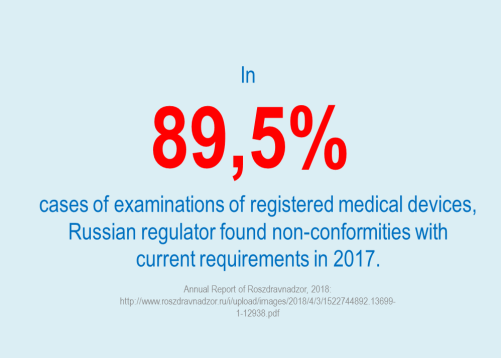
Regarding post-market control, the regulator reports about 5124 inspections and 827 examinations (expertises) of medical devices approved on the market which in 89.5 % cases revealed non-conformities of the examined medical devices with current Russian regulations.89,5.png

  1. Price Regulations for State Procurements of Medical Devices in Kazakhstan

At the end of March 2018, the Ministry of Health of Kazakhstan enforced Order #112 (link in Russian) and updated requirements on the registration of prices for medicines and medical devices for state procurements within the guaranteed free medical care. According to the document, medicines and medical devices may be purchased at prices not exceeding those established by the competent authority. The requirement is applicable for purchases by government institutions within the guaranteed free medical care or using health insurance funds.
Updated rules and guidelines for price and mark-up registrations have been published previously (link in Russian). Prices may be submitted online and should be registered by the competent authority within ten working days. The deadline for submission of information on prices was set as 27 April 2018 by the competent Kazakhstan authority (National Centre of Expertise).

  1. Several Eurasian Medical Device Regulations Approved

There was no breakthrough in start of functioning of Eurasian medical device regulations model in April 2018 compared to previous month; however, the Eurasian Commission approved several “third-level” regulations which come into force in May 2018:

-Regulation #46 on nomenclature of medical devices in EAEU (link in Russian);
-Regulation #47 on classification on adverse events for medical devices (link in Russian);
-Regulation #48 on classification of documents of the registration dossier (link in Russian).

In addition, one other interesting and detailed document published in April 2018 is the draft of the updated guidelines/recommendations for the expertise of medical devices for registration according to Eurasian requirements (link in Russian); however, as of the end of April 2018 the final approved version of the document is not available.

***

Thank you for following my blog, which is a non-commercial project with the objective to make Russian and Eurasian medical device regulations clearer. You can receive updates directly to your e-mail via the “Follow” button on the toolbar.

Three Things You Should Know about Medical Device Regulations in Russia, February 2018

Dear colleagues,

Welcome to my monthly update!

One may note that February 2018 was a fairly quiet month in the regulatory landscape for medical devices in Russia. However there are several recent minor updates which may be of interest:

  1. Updated List of Medical Products Taxed at 10% VAT

At the end of January 2018, the Russian government updated resolution # 688 with a list of medical products taxed at the reduced rate of value added tax (VAT) of 10% (link of updated resolution in Russian). An updated consolidated version of the list was aligned with the new national classification of products (enforced since January 2017).

In this context it should be recalled that Russian legislation grants VAT preferences (0% or 10% VAT instead of 18% as a ‘general rule’) for importing and selling most types of medical devices. The list of medical devices taxed at 0% was last updated in November 2017.


  1. List of Alcohol-Containing Medical Devices

At the end of January 2018, the draft regulation, ‘on formation of the list of alcohol-containing medical products’ (link in Russian), was published. According to the document, medical devices ‘in a liquid form of release containing the pharmaceutical substance of ethyl alcohol’ should be included in the special list by special commission of the Ministry of Health depending on a number of criteria (volume of consumer packaging, cost and functional purpose of a medical device). The commission is expected to revise the list no more than once a year and no later than 31st March. It is also expected that medical products included in the list will not be regulated by the Russian Law on State Regulation of Production and Turnover of Ethyl Alcohol and Alcohol-Containing Products, which was amended in January 2018.


  1. Weighted Average Prices for Polyvinylchloride Plastics Consumables

On 1st February 2018, the Russian Ministry of Health of the Russian Federation published a letter (link in Russian) proposing the updated weighted average prices for foreign disposable medical devices made of polyvinyl chloride plastics (PVC).

The weighted average prices are used for calculation of the guaranteed maximum price for state and municipal purchases according to the methodology provided in Order № 759N (link in Russian) by the Ministry of Health and the Ministry of Industry and Trade in October 2017.

A new scheme for the public procurement of consumable medical devices made from PVC was introduced in Russia in August 2017 with significant extension of the previously adopted Resolution No. 102 ‘On Establishing Access Restrictions for Certain Types of Foreign-Made Medical Products to Procurement for State and Municipal Needs’.


Thank you for following my updates!
Just to remind you that you may also follow Russian and Eurasian medical device regulatory updates on myTwitter @MedDevRus

Three Things You Should Know about Medical Device Regulations in Russia, January 2018

Dear Fellow Colleagues,


Welcome to my monthly newsletter with my selection of highlights in medical device regulations in Russia. Here are the most important updates for January.


  1. Road map to Development of Competition in Public Health Sector


On the 12th January 2018, the Russian Government published resolution #№9-р (link in Russian) with a roadmap to “developing competition in healthcare” for 2018–2019.
The published document contains a list of suggested strategic measures to develop competition in the public market for medicines, medical devices, healthcare services, and biologically active supplements in Russia, in the coming years.

A significant part of this document is devoted to changes in the regulation of medical devices expected in the next two years. Thus, among others, the following measures were suggested:


  • Development of the concept of medical devices of the “open” and “closed” types in terms of the possibility of using consumables or reagents from other manufacturers and the duty of the state and municipal customers to purchase medical products of an “open” type.
  • Development of the concept of the interchangeability of medical devices.
  • Introduction of a ban for manufacturers to set restrictions on the possibility of using consumables/reagents from other manufacturers.
  • Inclusion in the technical documentation for medical device information on the period of operation costs of technical maintenance and repair, costs of training medical personnel for the rules of application, and operation of the medical device.


The document also mentions a number of measures to improve and develop the regulation on the procedure of state and municipal procurement of medical products. The full text of the road map is available on the website of the Government of the Russian Federation.


  1. Checklists and Year Plan for Inspections


On the 26th January 2018, the Russian medical device regulator, Roszdravnadzor, published the approved forms of checklists (lists of control questions) that are used by the regulator during routine control inspections/audits of medical device manufacturers and other organisations involved in the turnover of medical devices in Russia.

In total, seven checklists have been published for the monitoring at each stage of the medical device lifecycle (control of pre-registration testing, clinical trials, usage and application in clinics, control of medical device manufacturers and its authorised representatives, technical maintenance, transportation, and storage). The checklists clarify whether organisations are complying with the mandatory requirements set by Russian medical device regulations and standards; they could also be a useful tool for audit preparation.

The list of organisations planned for inspection by Roszdravnadzor in 2018 has been published by the regulator in the beginning of January.
 

  1. Amendments to Regulation of Medical Products Containing Alcohol


On the 1st January 2018, article #14 of the Russian federal law #171 (link in Russian), the “regulation of turnover of ethyl alcohol, alcoholic, and alcohol-containing products” came into force. According to the updated regulations, Russian companies carrying out the production, manufacturing, and/or turnover of medical products containing alcohol exceeding 200 decilitres per year are obliged to register and declare this volume of alcohol-containing medical devices in accordance with the established procedure. The regulation defines an alcohol-containing medical device as “medical products in a liquid form of release containing a pharmaceutical substance of ethyl alcohol.”
Another amendment to this federal law was enforced in late December 2017 and establishes that until the 1st July 2018, non-declaring of this information by a company is not considered a violation.

*****

 Thank you for following this blog!
This is my non-commercial project whose objective is to make Russian and Eurasian medical device regulations clearer.
You can also receive updates directly to your e-mail via the “Follow” button on the toolbar.


Three Things You Should Know about Medical Device Regulatory Changes in Russia in 2017

Dear fellow colleagues,

Welcome to my end-of-year update. Today I want to share my vision and briefly summarise the most important changes, news, and trends in the Russian and developing Eurasian medical device regulation landscapes in 2017.


  1. Eurasian Medical Device Regulations – Summary of Changes, 2017

“In 2017, the formation of medicinal device legislation within the framework of the Eurasian Economic Union (EAEU) has been completed …. This is the most significant event of the year.” This was the message given by the head of Russian medical device regulator Roszdravnadzor at the conference in the Russian healthcare week in early December 2017.

We can see quite significant development of the EAEU medical device regulation system throughout the year of 2017. In March 2017, the registration and expertise fees for EAEU registration were published. Since May, twelve out of thirteen second-level regulations fully came into force and were gathered and published on the website of Roszdravnadzor.

The last and the most long-awaited document — EAEU requirements for the implementation of a quality management system for medical device manufacturers — was approved in November 2017.

By the end of the year, Russian laboratories started obtaining accreditation for conducting medical device testing according to EAEU medical device regulations. For the end of December 2017, there is information about three laboratories accredited for technical testing, one laboratory for toxicology/biocompatibility testing, and one centre for clinical trials on the website of the Russian medical device regulator. During several seminars on EAEU registration requirements, representatives of the laboratory confirmed the “green light” for the start of testing for registration.

This green light was also confirmed by EAEU member states; for example, the Belorussian Ministry of Health published information and documents for the submission of a registration file according to the Eurasian procedure. First companies report on the start of the EAEU registration process. However, for the end December 2017, there is no information on the possibility of submitting a registration file for EAEU evaluation in Russia.

It should be also recalled, that the end of the transition period introduced  in the Article 11 of the  Eurasian Agreement of Common Rules for Circulation of Medical Devices was set as 31 December 2021, and the requirement is that the re-registration (i.e. the full EAEU registration procedure) of all medical products in the EAEU market should be within less than four years. So far, no changes in this deadline nor information about the possibility of a simplified re-registration procedure have been formally announced.


  1. Changes in Russian Medical Device Regulations – Summary of Changes, 2017

Medical device approval in Russia still remains a very complex, time-and-resource consuming process. However, in parallel with the development of Eurasian medical device regulation, there were several significant positive changes in 2017.
Order #11N, containing a full list of requirements for the technical file and instructions (IFU) for the registration of medical devices and in-vitro diagnostics (IVD) in Russia, was published in March 2017 by the Russian Ministry of Health.

A pre-submission consultancy service was opened in 2017 by Russian regulatory expert centres involved in the registration process, with the aim of creating opportunities for manufacturers to receive formal feedback on specific aspects of the Russian regulatory process for their products from a competent authority prior to starting registration or submitting a medical device application. Until 2017, Russian legislation did not allow such forms of direct communication between manufacturers and registration experts.

An initiative for the simplification of the registration process for IVD has been discussed since the end of 2016. The draft regulation suggesting a one-step expert registration assessment for IVDs instead of the current two-step pathway was published at the beginning of August 2017, but at the end of the day of 27 December it has not yet been finally approved.

Russian medical device regulator Roszdravnadzor continues on a strong course to strengthen control of already approved medical devices in the market. Thus, the regulator announced there were more than 975 published “warning letters” about devices revealed to be in circulation that violated current legislation and more than one million units of non-registered or counterfeited devices banned and withdrawn from the market in the last year. It should be recalled that even a minor discrepancy in the product compared with the information submitted and approved in the registration file may be considered by the regulator as a violation and a reason for the ban.

  1. Continued Course on Restrictions for Foreign Medical Device Manufacturers

Restrictions on the admission of foreign medical products is the initiative started by the Russian government in February 2015, when Resolution #102 was introduced as a measure supporting the “import replacement” programme and “promoting the development of domestic manufacturing of medical devices”. As can be observed, the Russian government has continued on this course over the past year.

In August 2017, the Russian government adopted resolutions #967 and #968, aimed at creating modern competitive production of medical polyvinyl chloride (PVC) consumables in Russia, and  significantly extended the list of restricted medical devices. In particular, it introduced a separate list for six groups of consumables made of PVC and adopted a new approach to public procurement of these products.

In December 2017, a new decree, #1469, which indicated a temporary preference for Russian producers of coronary stents and catheters, established new restrictions on the admission of government purchases of these cardiac surgery products originating from foreign countries if at least one application from a Russian supplier is received. The restriction is effective until 1 July 2018.

At the end of the year, a new draft document was published by the Russian Ministry of Industry and Trade aimed at further expanding the restrictive list. The document contains twelve new types of products proposed for further restrictions, including test strips, dental composite filling materials, and endoprostheses.

******

I would like to take this opportunity to thank everyone for following my blog,  professional group and Twitter updates and wish all a very happy festive season and much success with Russian projects in 2018! Next year, I am going to continue my updates with the purpose of trying to make challenging Russian medical device regulatory system more clear for regulatory professionals.
I will be very glad of your comments, questions, and ideas!

Three Things You Should Know about Medical Device Regulations in Russia, September 2017

Dear Colleagues and Group Members,

This is a monthly update with a selection of the latest news on medical device regulation changes across Russia and the Eurasian Union.


  1. Development of Eurasian Medical Device Regulations


On 4 September 2017, the Eurasian Economic Commission published Recommendation No. 17, (link in Russian) ‘On the list of voluntary national standards that […] ensure conformity of a medical device with the Eurasian Essential Requirements for the Safety and Efficiency of Medical Devices’. The document harmonises existing national standards (155 voluntary standards for different types of medical devices and 43 standards for in-vitro devices) of the member states of the Eurasian Union and correlates them with the relevant requirements of the Essential Checklist.

In addition, earlier in September a number of drafts concerning medical device classifiers were published by the Eurasian Commission:

  • classifier of changes in the registration dossier of a medical device (link in Russian)
  • classifier of documents in the registration dossier of a medical device (link in Russian)
  • classifier of medical device area of usage (link in Russian).
    Usage of codes of the above classifiers are expected to be mandatory across several steps of medical device turnover in the Eurasian Union

At the same time, Roszdravnadzor (the Russian medical device regulator) created on its website the section ‘Registration of medical devices within the framework of the Eurasian Economic Union’, in which all Eurasian medical device regulations that came into force at that time were summarised.

Despite all published regulations, as of the end of September 2017, applications on Eurasian medical device registration process are still not working.


  1. Russian Ministry of Finance Clarified Rules for Medical Device Tax Exemptions

On 11 September 2017, the Ministry of Finance of the Russian Federation published a letter # СД-4-3/1794 (link in Russian) in which it recalled the rules for exemption from value added tax (VAT) when selling medical devices in Russia.

The regulator also confirmed the same VAT exemption for both ‘new’ and ‘old’ registration documents for the period 1 January 2017 to 30 June 2017 (i.e. the period before the amendment of the Russian tax code).

In this context it should be recalled that in February 2017, the Russian government published Resolution #160 (link in Russian) and extended to 1 January 2021 the deadline for the administrative replacement of the ‘old’ Russian medical device registration certificates.


  1. Medical Devices Incorporating a Medicinal Substance – Difficulties in Registration in Russia*

The registration of borderline products and medical devices with ancillary medicinal (pharmaceutical) substances is now one of the most pressing regulatory problems in Russia.

Resolution (Order) #11 N of the Russian Ministry of Health (link in Russian), which came into force in March 2017, requires the mandatory registration of all such chemical or pharmaceutical components as pharmaceutical substances in the Russian Federation.

On 25 September 2017, 38 manufacturers and distributors of medical devices in Russia submitted a collective letter to Russian medical device regulator Roszdravnadzor, the Ministry of Health, and the Ministry of Industry and Trade, in which they drew attention to serious difficulties with, and in some cases the impossibility of, state registration of whole groups of medical devices (for example, dental cements and adhesives, drug-eluting stents, cosmetic fillers…) under new requirements.

The petition contains an analysis of the current regulations of borderline products and medical devices with ancillary medicinal (pharmaceutical) substances, as well as a request to regulators to clarify their position on this issue and correct contradictions in legislation. The issue has received wide coverage in the Russian media.


*****

* I would like to express my thanks to Medrelic – a Russian consulting company for the registration and certification of medical devices – for kindly providing material and sharing expertise on issues regarding the registration of medical devices incorporating pharmaceutical substances.

Russia Opens Pre-submission Consultancy for Medical Device Manufacturers


On 10 September 2017, the order #6478 (link in Russian) came into force.
This order introduces pre-submission consultations from Russian regulatory expert centers involved in the registration process to medical device manufacturers for requesting feedback prior to start registration, local testing or submitting a medical device application to Roszdravnadzor (Russian medical device regulator) as far as discussing specific aspects of the Russian regulatory process and requirements (e.g. medical device classifications and designation of a product to medical device regulations).

Until now, Russian law did not allow such forms of consultancy, and direct communication between manufacturers and authorities on any specific question was formally prohibited.

Consultations will be paid for medical device manufacturers but not mandatory for obtaining approval.

Three Things You Should Know about Medical Device Regulations in Russia, August 2017


Dear Colleagues and Group Members,

Here is my monthly newsletter with the most important regulatory updates on medical devices in Russia for August 2017.


  1. Restrictions for Plastic Consumables

In August 2017, the Russian government introduced two important regulations affecting public procurements of a broad range of medical devices made from polyvinyl chloride (PVC) plastics.
According to Resolution # 967 (link in Russian), which came into force on 25 August 2017, suppliers to the Russian market of medical devices manufactured with PVC will from now on be determined from the list of organizations implementing projects to localize the production of medical products in Russia in 2017–2024. The Resolution also sets rules for selecting such suppliers. In particular, organizations must have the right to technical documentation for the respective devices for a period of not less than ten years, and use technologies and raw materials developed within the framework of the Russian “Development of the pharmaceutical and medical industry” programme for 2013–2020.
At the same time, another adopted Resolution # 968 (link in Russian) includes six groups of disposables made of PVC plastics in the list of medical products for which state procurement from foreign manufacturers will be limited  (according to the Resolution #102 dated from February 2015).


  1. Draft Resolution on Changes to Russian Medical Device Registration Rules

The draft Resolution on Amendments to State Registration of Medical Devices is another important document which was published (link to the draft in Russian) at the beginning of August 2017. The main change proposed in the draft is a simplification of registration of in-vitro diagnostics (IVD): by analogy with the simplification of procedures for I class devices introduced in 2015, the document proposes one-step expert assessment (so called expertise) for registration instead of the current two-step pathway. Another possible innovation proposed in the draft is a significant change of procedure in the amendment of registration certificates and registration dossiers (product re-registration): it proposes a list of changes which do not require expert assessment for re-registration, and establishes a timeline for such re-registration as 15 working days.
As of the end of August 2017, a draft of the document is undergoing regulatory impact assessment by Russian authorities.
 

  1. Adopted Changes in Alcohol Regulations will affect some Medical Devices

On 29 July 2017, Russian authorities adopted Federal Law № 278-FZ (link in Russian), which changes measures to control the turnover/distribution of pharmaceutical substances of ethyl alcohol, including in the production of alcohol-containing medical devices. The regulation defines “alcohol-containing medical device” as a medical device in a liquid form, containing a pharmaceutical substance of ethyl alcohol (ethanol). The published law requires, in particular, additional registration and declaration procedures for legal entities that carry out the manufacturing and turnover/distribution of alcohol-containing medical devices in Russia. According to the regulation, lists of exceptions are established, i.e. “alcohol-containing medical devices” not covered by this regulation. These changes will become operative from 1 January 2018.


Thank you for following this blog, whose objective is to make Russian and Eurasian medical device regulations clearer. You can receive updates directly to your e-mail via the “Follow” button on the toolbar.

Three Things You Should Know About Medical Device Regulations in Russia, July 2017


 Dear Colleagues and Group Members,

Welcome to my summer update, with my usual selection of highlights for medical device regulatory professionals who are interested in what is going on in Russia and the Eurasian Economic Union:


  1. Will New GMO Regulations Affect Medical Devices?

On 1st July 2017, rules for the mandatory state registration of genetically modified organisms (GMO) and products containing such organisms came into force in Russia.

Initially introduced by Government Resolution No. 839 (link in Russian) in September 2013, these rules were modified at the end of June 2017 by Resolution No. 770 (link in Russian). The scope of these rules was narrowed down for GMO “intended for release into the environment” only, and at the same time medicinal products and medical devices were excluded from the scope of these rules.

For today, paragraph four of the newly implemented rules underlines that GMO products containing medical devices must be registered within the framework of the established existing medical device registration procedure.

Thus, according to the current legislation for today, medical devices containing GMOs de jure will not require any separate or additional state registration procedure. It is not yet clear, however, if in practice it affects more detailed investigations of medical devices containing genetically modified cells or its products.

GMOs are currently used to produce components of multiple medical products, e.g. recombinant vaccines, clotting factors to treat haemophilia, human growth hormones, recombinant insulin, components of some in-vitro reagents, etc.


  1. Deadline for Submitting Applications on Prices for Implantable Devices

On 14th July 2017, the deadline passed for medical device manufacturers to submit applications to Roszdravnadzor (Russian healthcare regulator) for the state registration of the maximum selling prices for implantable medical devices.
In this framework, two databases have been recently published on Roszdravnadzor’s website:

  • The database with information on average prices for medical products classified according to Russian nomenclature classification (link in Russian).
  • State register of maximum sales prices for implantable medical devices included in the list of medical products for the programmes of state guarantees of free medical care to citizens (link in Russian).

The procedure for the regulation of prices for implantable medical devices was approved and has been developed by the Russian government since 2015. According to Resolution No. 1517, the price offered by the manufacturer cannot exceed the weighted average selling price, which is calculated by Roszdravnadzor.


  1. Eurasian Registration – Requirements for Electronic Submission

On 30th June , the Eurasian Economic Commission published Decision No. 78, “On Requirements for the Electronic Form of Applications and Documents of the Registration Dossier Submitted for Registration of Medical Devices” (link in Russian). The document defines requirements for the structure of the registration file for electronic submission, and rules for the completion of documents in electronic form submitted by the applicant to authorised Bodies of the Member States for registration of medical devices.

As of the end of July 2017, there is still no information that the medical device registration process according to harmonised Eurasian rules is working, whereas most of the Eurasian regulations have been formally enforced.

Three Things You Should Know About Medical Device Regulation in Russia and CIS, June 2017


Dear Colleagues and Group Members,

This is a monthly update with my selection of highlights for June 2017 on medical device regulation changes across Russia and CIS:

 1. Ukraine Completely Switched to New Medical Device Approval System

1 July 2017 is the end of the transition period from the system of state registration of medical devices to the assessment of conformity with Ukrainian Technical Regulations No.753, No. 754 and No.755.
After this date, medical devices approved under the “old” procedure that were put onto the Ukrainian market before this date will be allowed for distribution without passing the conformity assessment procedure and without a conformity mark. According to new regulations, these products will be allowed to be on the market before the end of their shelf lives, but not for more than five years from the date of their introduction into circulation.

The new Ukrainian medical device approval system is currently very similar to the European medical device and In-Vitro Diagnostics (IVDs) approval process, however the CE mark itself does not entitle a product to be placed on the Ukrainian market without meeting the requirements of local technical regulations.

The new Ukrainian medical device conformity assessment procedure is defined depending on safety class. The most common ways of assessment today include audits of manufacturing sites or batch conformity assessments. Low-class medical devices are mostly self-declared.

Other important requirements of the new approval system include the mandatory appointment of authorised representatives of manufacturers in Ukraine and mandatory use of  Ukrainian language on the product labelling.

At the end of June 2017, the Ukrainian state register of medical devices contained 3764 approved devices, while the website of the Ukrainian Ministry of Health listed 13 accredited notification bodies for medical devices and eight notification bodies for IVDs.


2. Deadline for Price Registration for Implantable Devices in Russia
Another important date on the Russian regulatory landscape is 15 July 2017 – this deadline was set by Resolution 1517 (link in Russian) for manufacturers of implantable medical devices and their authorised representatives to submit documents to Roszdravnadzor, the Russian healthcare regulator, for the registration of maximum sale prices for implantable medical devices included in the list for the programme of state guarantees for free provision of medical care (link to the last version of the list in Russian). A list of documents for price registration is defined in Clause 4 of the price registration rules (link in Russian). According to these rules, with proper preparation of the documents, a decision on the price registration should be taken by the regulator within five business days. Meanwhile, in June 2017 the Russian regulator started publishing information about “average-weighted” prices agreed with the Russian Federal Anti-Monopoly Service (FAS). Published prices were provided using a Russian nomenclature classification system.

3. Further Development of the Eurasian Medical Device Regulation Model

After the formal entry of documents at the second level of the Eurasian harmonised system for regulating the circulation of medical devices came into force in May 2017, this system continues to develop. Thus, in June 2017, the Eurasian Commission published drafts of a number of new third-level documents:

  • On the classifier of the types of adverse events associated with the use of medical devices (link in Russian)
  • On the classifier of kinds of documents of the registration dossier on a medical device (link in Russian)
  • On the nomenclature of medical devices (link in Russian)
  • On the Consultancy Committee on Medical Devices (link in Russian).

From today, documents are available as drafts, which remain under public discussion status until the end of July.


*****

I would like to thank IMPROVE MEDICAL for providing updates on the development of Ukrainian medical device regulations. The IMPROVE MEDICAL conformity assessment body is based in Kyiv and performs conformity assessment with Ukrainian technical regulations for medical products.

You can also follow my news subscription on this page or on Twitter @MedDevRus