Three Things You Should Know about Medical Device Regulations in Russia and the Eurasian Economic Union, June 2016


Dear colleagues and group members,

Traditionally, summertime is not a very hot season for regulatory updates, so I am glad to share these three important highlights for medical devices in Russia and the Eurasian Economic Union (EEU):


  1. Update on Eurasian Medical Device Regulatory Model

On 2 June 2016 the Eurasian Commission published final versions of two second-level pieces of legislation for the harmonized Eurasian medical device regulatory system:

  1. Rules for Biocompatibility Testing of Medical Devices (link in Russian)
  2. List of Medical Devices with Measuring Function (link in Russian)

As at the end of June 2016, ten out of thirteen final versions of the Eurasian medical device regulations have been published. The final versions of two of the most crucial documents – “Eurasian Medical Device Registration Rules” and “Guidance for a Quality Management System for Medical Device Manufacturers” are still under discussion between member states and are expected within the near future.

Recall that although the Agreement on Common Principles and Rules of Circulation of Medical Devices formally came into force at the beginning of 2016, the new system is still not working.


  1. Discussions around price registration for medical devices

Some implantable medical devices (i.e. intended for fixation, delivery or extraction of implants or preparation for implantation procedure) may be removed from the “List of Implantable Medical Devices for Medical Aid Provided to Citizens under the Programme of State Guarantees of Free Medical Care” and exempted from the mandatory requirement of price registration. In June the draft law (link in Russian) was prepared and sent to the Russian parliament for discussion and approval.

In this context it should be recalled that 15 July 2016 is the deadline set by the Russian medical device regulator Roszdravnadzor for manufacturers of implantable devices to provide the regulator with information about the prices of their products.


  1. Clear identification of the medical device is critical for proper registration

In June, the Russian press loudly reported a story illustrating an example from current Russian medical device regulatory practice. Because of revealed discrepancies in the Russian registration certificate, Roszdravnadzor deemed the medical devices as non-[properly]-registered, and after that banned products of the UK manufacturer and one of the market leaders in its segment (read more in English).

Over the last few years Roszdravnadzor has increased controls on medical devices and requires notifying about any changes in product name or technical parameters of a registered device to ensure consistency between the registration certificate and the previously submitted registration file. Moreover, in contrast to previous registration rules, which allowed common “family” or “umbrella” registrations, clear identification of the brand name and model of the medical device is mandatory for proper medical device registration.

If you like my updates about Russian medical device regulations you can follow me on twitter @MedDevRus or get them directly via e-mail using the “Follow” button on the toolbar of this page.

Three Things You Should Know about Medical Device Regulations in Russia, March 2016

Dear colleagues,

Let me share the most important news and updates from the Russian medical device regulatory landscape in March 2016:

  1. Detailed Statistics on Medical Device Registration Processes in Russia in 2015

At the beginning of March 2016, Roszdravnadzor (the Russian medical device regulator) published an annual report with detailed statistics on medical device registration procedures in 2015.

According to this document, over the last year, the regulator received and reviewed 1985 registration submissions, among which 1052 (52%) medical devices were approved (447 for Russian manufacturers and 605 for foreign manufacturers). Another 2705 files were submitted for amendment of existing registration certificates (the so-called ВИРУ procedure), with 1853 (68%) receiving approval. The regulator also reported 1307 authorizations for clinical trials of medical devices, 698 administrative renewals of registration certificates, and 1229 authorizations of samples for pre-submission testing in 2015.

Interesting statistics were also provided on submissions of notifications about changes in technical documentation for approved medical devices (a requirement since 2015), with the regulator making 302 approvals and 312 rejections on these submissions over the last year.
A full version of the report (in Russian) is available on the IMEDA website.


  1. Possible Extension of the Transition Period for Medical Device Registrations in Ukraine

From today, there are almost three months left until the end of the transitional period set last year by the Ukrainian Government for medical device manufacturers. Currently, for a significant proportion of medical devices available on the Ukrainian market, approval was received before July 2015 via the old registration procedure; current rules allow such medical products to be imported for sale until 1 July 2016, after which they can be used until the documented product service or shelf life expiration date.

However, the Government of Ukraine is now discussing (link in Ukrainian) extending this transitional period to 1 July 2017. This is happening in parallel with another legal initiative (link in Ukrainian) aimed to ensure the national register retains information about medical devices registered before July 2015, with registration information kept until at least June 2020.

It should be recalled that, since July 2015, medical devices in Ukraine can be approved only through new conformity assessment procedures, as evaluated by the relevant Ukrainian notification body (currently, more than ten conformity assessment centres operate in Ukraine).


  1. The Russian Ministry of Health is Updating Requirements for Medical Device Technical Files

In recent years, it has become widely accepted that the failure of regulatory bodies to provide full and clear requirements for assessing the technical files of a medical device poses a major challenge within current registration procedures. According to reports from expert organizations, more than 50% of additional requests during the approval process, as well as registration delays, are related to discrepancies or lack of information in the technical documentation of the registration file. Moreover, in practice, current approaches to reviewing technical documentation may differ depending on the organization reviewing the device.

The Russian Ministry of Health is therefore currently developing new regulations in order to establish transparent criteria for evaluating the technical and operational documentation of medical devices, which will simplify the registration procedure. According to the official website, these new requirements are expected to be finalized by June 2016.

*****

The objective of this blog is to help regulatory professionals better understand the Russian medical device regulatory system. Please post your comments and questions here or in the Russian medical device regulations LinkedIn group.

Russia is among the Most Difficult Markets to Enter

Based on the responses of 2,062 industry professionals published in the Global Medical Device IndustryOutlook for 2016 by Emergo Group, Russia and China traditionally was most often cited as more difficult markets to enter.

58 percent of respondents consider that the process of obtaining regulatory approval for a medical device in Russia in 2015 became more difficult than before and only 2 percent of professionals believe that situation became better.

Russia


In the same time Roszdravnadzor (Russian medical device regulator) in December 2015 said about “good dynamics” and showed positive trends in medical device approvals.


Data published with kind permission of Emergo Group


One Year to Replace “Old” Registration Certificates.

Why?

According to clause #2 of Russian Medical Device Registration Rules (Resolution 1416):

Medical device and medical equipment registration certificates with an unlimited validity period, issued before the effective date of this Resolution, shall be valid until and be replaced on January 1, 2017, with registration certificates in the format approved by the Federal Service for Healthcare Supervision (Roszdravnadzor).

A registration certificate shall be replaced without the repeated state registration of medical devices, on the basis of the application submitted by the applicant to the Federal Service for Healthcare Supervision and containing the information envisaged in the Rules provided for by this Resolution.

Does my certificate need replacement?

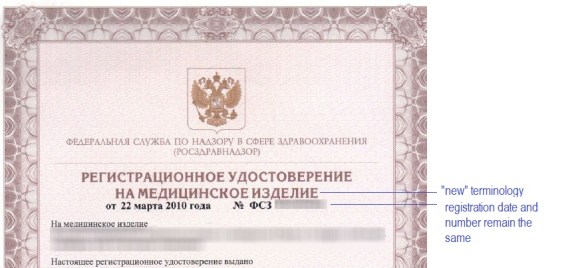
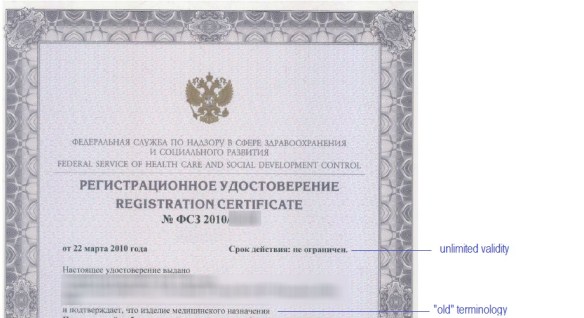
How does registration certificate with an unlimited validity period look like (need replacement by 01.01.2017):

old registration1

How does new format registration certificate look like:

new registration1

What is the process?

  1. Sign the Power of Attorney/Autorization letter in the name of Russian Autorized Representative (legalization with apostile is required).
  2. Complete the application form;
  3. Submit the file to Roszdravnadzor (1+2+a scan copy of “old” certificate);
  4. Review time 2-4 weeks (for Q4 2015);
  5. Return paper copy of “old” certificate and get the new one.

ФармМедОбращение: Пять вопросов об обращении медицинских изделий в Евразийском Cоюзе

FMO 20151019

You can read the English version of this post

Менее трех месяцев остается до вступления в силу  Соглашения о единых принципах и правилах обращения медицинских изделий Евразийского Экономического Союза.  В рамках конференции ФармМедОбращение 19 октября состоялась специальная сессия, посвященная этому событию.

Представителем Евразийской экономической комиссии был сделан доклад о статусе нормативных документов второго уровня к подписанному Соглашению. В докладе сообщалось, что на сегодняшний день все документы (всего 13 нормативных актов) по-прежнему находятся в разных стадиях разработки и согласования.  Было отмечено, что документы «находятся в высокой степени готовности» однако  на сегодняшний день Комиссией не принято ни одного готового документа. Отмечено также,  что возможные правки в проекты разрабатываемых документов «будут носить административный характер», и документы будут «приняты в очень похожих редакциях».

Представителями Росздравнадзора было высказано мнение, что с высокой долей вероятности в переходный период, предусмотренный в гл.11 Соглашения,  будет возможна работа по двум параллельным процедурам: локальной процедуре регистрации страны (то есть процедуре регистрации, действующей на сегодняшний день) и новой процедуре регистрации Евразийского союза, что позволит “избежать повторения болезненного российского опыта 2013 года”.
Сроком действия «локальных» разрешительных документов по-прежнему остается 31 декабря 2021 года.

Очередными ориентирами для возможной готовности части документов была обозначена конференция «Медицина и качество» в начале декабря 2015 года.

Ниже я хотел бы привести ответы на 5 вопросов, заданных из зала на эту тему:

  1. Медицинское изделие зарегистрировано сегодня в России. Возможно ли его обращение в странах Евразийского союза после 01 января 2016 года?
    Ответ: Нет. Медицинские изделия, зарегистрированные в странах Союза по локальным процедурам, останутся разрешенными к применению только в стране регистрации. Для разрешения обращения в рамках Союза необходима регистрация по новой процедуре.
  2. Досье будет подано на регистрацию 31 декабря 2015 года. По какой процедуре пойдет регистрация?
    Ответ: В этом случае регистрация пойдет по локальной процедуре страны.
  3. Во время переходного периода будет ли у заявителя возможность выбора, по какой процедуре подавать заявление?
    Ответ: Да, во время переходного периода у заявителя предполагается возможность выбора между локальной процедурой страны и новой «гармонизированной» процедурой союза.
  4. Требуется ли маркировка новым знаком обращения медицинских изделий с 01 января 2016?
    Ответ: Маркировка новым знаком обращения предполагается для медицинских изделий, разрешенных по новой процедуре Евразийского союза. Для медицинских изделий, зарегистрированных до 01 января 2016 года, новый знак обращения не наносится.
  5. Отменяет ли вступление в силу общих правил обращения медицинских изделий требование к замене бессрочных российских регистрационных удостоверений «старого образца»?Ответ:  Нет, бессрочные регистрационные удостоверения, выданные до 01 января 2013 года, необходимо заменить на новые до 01 января 2017 года.

Three Things You Should Know about Medical Device Regulations in Russia and CIS – September 2015

Dear colleagues,

This is my monthly update on what is happening in terms of medical device regulations in Russia, the Eurasian customs union, and CIS. As you probably remember, there are only three months left before the new, harmonised Eurasian regulations come into force in January 2016. Meanwhile, September was a rather quiet month in terms of surprises for Russia. Here are my highlights for the region:

  1. Will New Russian Law on Personal Data Affect the Medical Device Sector?

Let me start with highly debated and strategic legal initiative. On 1 September, Russia implemented amendments to Federal Law #152 (link in Russian) “on the processing of personal data in information and telecommunication networks”. The amendments require companies to store personal data about Russian citizens on Russian territory. The law broadly defines personal data as “any information relating directly or indirectly to an identified or identifiable natural person (the subject of the personal data)”. The provisions of the new law are not only strict, but the number of issues remain unclear – particularly for the medical device industry. How will this regulation affect medical device data systems, medical image storage devices, medical communications devices, or any other medical software (or hardware) that transfers, stores, and converts medical patient data, and medical records? How will this law be implemented in terms of data processing for clinical trials of medicines and medical devices? Could this regulation be left unimplemented in terms of medical devices? As you see, there are a number of unanswered questions and nuances that need to be clarified in the coming months.

  1. Changes in the Registration Procedure for Kazakhstan

The Ministry of Health of Kazakhstan has enforced changes to the procedure of registration of medical devices. The new rules have been approved and published in decree #524 (link in Russian). The Kazak approval agency highlighted that the main changes to the procedure relate to the registration application form, which henceforth should be completed in either the Russian and Kazak language, it should contain a GMDN code (if applicable), and information about the prices of medical devices for further price monitoring. The changes also concern the list of documents required for the registration dossier (e.g. requirements in terms of legalisation and bilingual Russian-Kazak packaging design). The new rules have tightened the timeframes for an applicant to respond to additional inquiries from the approval agency after submission. Henceforth, if an applicant does not provide a response within thirty days, the registration could be formally rejected. It should be noted that the medical device registration procedure in Kazakhstan takes from 90 to 160 business days depending on safety class.

  1. Ukrainian Ministry of Health is Discussing the Prolongation of the Transitional Period for the New Approval process for Registered Medical Devices

In September 2015, the Ukrainian Ministry of Health circulated the DRAFT of the of the decree (link in Ukranian) suggesting the prolongation of the transitional period (until 1 July 2017) for the change to the new conformity assessment approval procedures for medical devices that was already registered in Ukraine before 1 July 2015. Previously this deadline was set as 1 July 2016. The document introduced additional requirements for devices imported in this period to be used within their operational period, but not for longer than five years. Meanwhile, for all non-resident medical device manufacturers, the establishment of an authorised Ukrainian representative remains mandatory for the approval and commercialisation of a medical device. As you will recall, since 1 July 2015 access for medical devices into the Ukrainian market must be subject to a new conformity assessment approval process that requires the acquisition of a special conformity mark.

Thank you for following the newsletter. I am always grateful for your comments and encourage you to ask specific questions in the group.

Alexey Stepanov
Alexey@MedicalDevicesInRussia.com
@MedDevRus

Medical Device Registration Fees for Emerging Markets – Analysis by Emergo.

Emergo Group published an interesting review about market entry fees for medical devices for emerging markets. Compared to Brazil and China, Russian registration fees remain rather modest, meanwhile it should be noted that Roszdravnadzor`s fees are just a part of Russian registration budget

Read more on Emergo Blog

Do you consider Roszdravnadzor fees as a significant factor to make a descision to register a medical device in Russia?

I would be grateful for your comments!