Three Things You Should Know about Medical Device Regulatory Changes in Russia in 2017

Dear fellow colleagues,

Welcome to my end-of-year update. Today I want to share my vision and briefly summarise the most important changes, news, and trends in the Russian and developing Eurasian medical device regulation landscapes in 2017.


  1. Eurasian Medical Device Regulations – Summary of Changes, 2017

“In 2017, the formation of medicinal device legislation within the framework of the Eurasian Economic Union (EAEU) has been completed …. This is the most significant event of the year.” This was the message given by the head of Russian medical device regulator Roszdravnadzor at the conference in the Russian healthcare week in early December 2017.

We can see quite significant development of the EAEU medical device regulation system throughout the year of 2017. In March 2017, the registration and expertise fees for EAEU registration were published. Since May, twelve out of thirteen second-level regulations fully came into force and were gathered and published on the website of Roszdravnadzor.

The last and the most long-awaited document — EAEU requirements for the implementation of a quality management system for medical device manufacturers — was approved in November 2017.

By the end of the year, Russian laboratories started obtaining accreditation for conducting medical device testing according to EAEU medical device regulations. For the end of December 2017, there is information about three laboratories accredited for technical testing, one laboratory for toxicology/biocompatibility testing, and one centre for clinical trials on the website of the Russian medical device regulator. During several seminars on EAEU registration requirements, representatives of the laboratory confirmed the “green light” for the start of testing for registration.

This green light was also confirmed by EAEU member states; for example, the Belorussian Ministry of Health published information and documents for the submission of a registration file according to the Eurasian procedure. First companies report on the start of the EAEU registration process. However, for the end December 2017, there is no information on the possibility of submitting a registration file for EAEU evaluation in Russia.

It should be also recalled, that the end of the transition period introduced  in the Article 11 of the  Eurasian Agreement of Common Rules for Circulation of Medical Devices was set as 31 December 2021, and the requirement is that the re-registration (i.e. the full EAEU registration procedure) of all medical products in the EAEU market should be within less than four years. So far, no changes in this deadline nor information about the possibility of a simplified re-registration procedure have been formally announced.


  1. Changes in Russian Medical Device Regulations – Summary of Changes, 2017

Medical device approval in Russia still remains a very complex, time-and-resource consuming process. However, in parallel with the development of Eurasian medical device regulation, there were several significant positive changes in 2017.
Order #11N, containing a full list of requirements for the technical file and instructions (IFU) for the registration of medical devices and in-vitro diagnostics (IVD) in Russia, was published in March 2017 by the Russian Ministry of Health.

A pre-submission consultancy service was opened in 2017 by Russian regulatory expert centres involved in the registration process, with the aim of creating opportunities for manufacturers to receive formal feedback on specific aspects of the Russian regulatory process for their products from a competent authority prior to starting registration or submitting a medical device application. Until 2017, Russian legislation did not allow such forms of direct communication between manufacturers and registration experts.

An initiative for the simplification of the registration process for IVD has been discussed since the end of 2016. The draft regulation suggesting a one-step expert registration assessment for IVDs instead of the current two-step pathway was published at the beginning of August 2017, but at the end of the day of 27 December it has not yet been finally approved.

Russian medical device regulator Roszdravnadzor continues on a strong course to strengthen control of already approved medical devices in the market. Thus, the regulator announced there were more than 975 published “warning letters” about devices revealed to be in circulation that violated current legislation and more than one million units of non-registered or counterfeited devices banned and withdrawn from the market in the last year. It should be recalled that even a minor discrepancy in the product compared with the information submitted and approved in the registration file may be considered by the regulator as a violation and a reason for the ban.

  1. Continued Course on Restrictions for Foreign Medical Device Manufacturers

Restrictions on the admission of foreign medical products is the initiative started by the Russian government in February 2015, when Resolution #102 was introduced as a measure supporting the “import replacement” programme and “promoting the development of domestic manufacturing of medical devices”. As can be observed, the Russian government has continued on this course over the past year.

In August 2017, the Russian government adopted resolutions #967 and #968, aimed at creating modern competitive production of medical polyvinyl chloride (PVC) consumables in Russia, and  significantly extended the list of restricted medical devices. In particular, it introduced a separate list for six groups of consumables made of PVC and adopted a new approach to public procurement of these products.

In December 2017, a new decree, #1469, which indicated a temporary preference for Russian producers of coronary stents and catheters, established new restrictions on the admission of government purchases of these cardiac surgery products originating from foreign countries if at least one application from a Russian supplier is received. The restriction is effective until 1 July 2018.

At the end of the year, a new draft document was published by the Russian Ministry of Industry and Trade aimed at further expanding the restrictive list. The document contains twelve new types of products proposed for further restrictions, including test strips, dental composite filling materials, and endoprostheses.

******

I would like to take this opportunity to thank everyone for following my blog,  professional group and Twitter updates and wish all a very happy festive season and much success with Russian projects in 2018! Next year, I am going to continue my updates with the purpose of trying to make challenging Russian medical device regulatory system more clear for regulatory professionals.
I will be very glad of your comments, questions, and ideas!
Three Things You Should Know about Medical Device Regulations in the Eurasian Union, October 2017


Dear colleagues and group members,

In October 2017 my usual newsletter will focus on updates in developing harmonised Eurasian medical device regulatory system.


  1. Eurasian Quality Management System Requirements for Medical Device Manufacturers

In early October 2017, the Eurasian Commission published decision 134 (link in Russian), which includes what is requirements for a quality management system (QMS) for manufacturers of medical devices.
This decision is the last of the “second level” documents approved in the harmonised Eurasian model.

According to the published regulation, the implementation, development and maintenance of the QMS is becoming mandatory for the registration of  sterile IIA, IIB, III class devices. For low class devices (I and non-sterile IIA class products) QMS maintenance is not formally mandatory,however, it offers the advantage of a simplified amendment/re-registration procedure (notification instead of assessment).

The document contains checklists with requirements for every QMS subsystem: design and development controls, record/document change control, corrective and preventive actions, production and process control and consumer-related processes.

The assessment of the QMS is a mandatory step in the registration process and is carried out by way of an inspection audit of every declared manufacturing site by accredited organisations of Eurasian member states (according to the document, there is a list of accredited organisations maintained by the regulator of each member state, and the manufacturer may apply to any of them).

In addition to the primary “registration” inspection audit periodic post-registration QMS assessment inspections are also requited once every three years, as well as unscheduled inspections in limited cases.

The document introduces a twelve-month transitional period, during which QMS assessment is not mandatory for the registration. During this period, the submission of an ISO 13485 certificate provides a presumption of conformity with quality requirements when the QMS inspection audit is postponed (within a two-year period after registration).


  1. Russian Laboratories are Preparing to Start Medical Device Testing According to Harmonised Eurasian Requirements

In early October 2017, the Russian medical device expert centre (VNIIMT (ВНИИМТ) published information about its inclusion in the list of organisations accredited for technical and biological testing for the registration of medical devices according to the Eurasian procedure.

Later, on 27 October, during the seminar on Eurasian medical device testing requirements held by the same organisation, it was confirmed that manufacturers may apply for start testing according to the new requirements.

At the end of October 2017, there are two laboratories accredited for testing according to Eurasian requirements. The list is published on the website of the Russian medical device regulator Roszdravnadzor.

It should be noted that the Eurasian medical device regulation model contains separate requirements for technical (link in Russian) and biological safety (link in Russian) testing, which must be conducted in an accredited laboratory in any Eurasian member state.


  1. Eurasian Advisory Committee on Medical Devices

Another document adopted by the Eurasian commission in October is decision 123 (link in Russian) “On the Regulations on the Advisory Committee on Medical Products”. According to the text in the published document the Advisory Committee is a new regulatory body on the Eurasian level which will be responsible for adjusting differences between Eurasian member states (i.e., the reference state and acceptance state) during the process of medical device registration assessment. The committee’s tasks also include consultations on issues in the field of medical devices.

*****

Thank you for following this blog! My objective here is to make developing Eurasian medical device regulations clearer. You can also follow my updates on Twitter @MedDevRus.

First Laboratory for Testing Medical Devices according Eurasian Registration Rules

Significant milestone in the development of Eursian harmonized medical device regulation model …The first data on laboratories performing testing of medical devices according to the Eurasian Registration Rules became available.

According to the information appeared on the website of the expert organization and Russian medical device regulator Roszdravnadzor at the beginning of October 2017, Russian medical device expert center VNIIMT (ВНИИМТ) has been included in the list of organizations for technical and biological testing for registration of medical devices in Eurasian Union.

It is to be recalled, that prior to registration according to the Eurasian Union procedure, a medical device must be tested in the laboratory from the “approved” list in any of Eurasian member states.

Eurasian Medical Device Quality Management System Requirements

The Eurasian Economic Commission published the Order # 134 (link in Russian) and approved the draft resolution on requirements on quality management system (QMS) for medical device manufacturers in Eurasian Union. This news was published on 2nd October 2017 on the website of the Eurasian commission and the Russian medical device regulator Roszdravnadzor.
The requirement on QMS is the thirteenth and the last adopted ‘‘second level’’ document of Eurasian medical device regulation model.

Three Things You Should Know about Medical Device Regulations in Russia, September 2017

Dear Colleagues and Group Members,

This is a monthly update with a selection of the latest news on medical device regulation changes across Russia and the Eurasian Union.


  1. Development of Eurasian Medical Device Regulations


On 4 September 2017, the Eurasian Economic Commission published Recommendation No. 17, (link in Russian) ‘On the list of voluntary national standards that […] ensure conformity of a medical device with the Eurasian Essential Requirements for the Safety and Efficiency of Medical Devices’. The document harmonises existing national standards (155 voluntary standards for different types of medical devices and 43 standards for in-vitro devices) of the member states of the Eurasian Union and correlates them with the relevant requirements of the Essential Checklist.

In addition, earlier in September a number of drafts concerning medical device classifiers were published by the Eurasian Commission:

  • classifier of changes in the registration dossier of a medical device (link in Russian)
  • classifier of documents in the registration dossier of a medical device (link in Russian)
  • classifier of medical device area of usage (link in Russian).
    Usage of codes of the above classifiers are expected to be mandatory across several steps of medical device turnover in the Eurasian Union

At the same time, Roszdravnadzor (the Russian medical device regulator) created on its website the section ‘Registration of medical devices within the framework of the Eurasian Economic Union’, in which all Eurasian medical device regulations that came into force at that time were summarised.

Despite all published regulations, as of the end of September 2017, applications on Eurasian medical device registration process are still not working.


  1. Russian Ministry of Finance Clarified Rules for Medical Device Tax Exemptions

On 11 September 2017, the Ministry of Finance of the Russian Federation published a letter # СД-4-3/1794 (link in Russian) in which it recalled the rules for exemption from value added tax (VAT) when selling medical devices in Russia.

The regulator also confirmed the same VAT exemption for both ‘new’ and ‘old’ registration documents for the period 1 January 2017 to 30 June 2017 (i.e. the period before the amendment of the Russian tax code).

In this context it should be recalled that in February 2017, the Russian government published Resolution #160 (link in Russian) and extended to 1 January 2021 the deadline for the administrative replacement of the ‘old’ Russian medical device registration certificates.


  1. Medical Devices Incorporating a Medicinal Substance – Difficulties in Registration in Russia*

The registration of borderline products and medical devices with ancillary medicinal (pharmaceutical) substances is now one of the most pressing regulatory problems in Russia.

Resolution (Order) #11 N of the Russian Ministry of Health (link in Russian), which came into force in March 2017, requires the mandatory registration of all such chemical or pharmaceutical components as pharmaceutical substances in the Russian Federation.

On 25 September 2017, 38 manufacturers and distributors of medical devices in Russia submitted a collective letter to Russian medical device regulator Roszdravnadzor, the Ministry of Health, and the Ministry of Industry and Trade, in which they drew attention to serious difficulties with, and in some cases the impossibility of, state registration of whole groups of medical devices (for example, dental cements and adhesives, drug-eluting stents, cosmetic fillers…) under new requirements.

The petition contains an analysis of the current regulations of borderline products and medical devices with ancillary medicinal (pharmaceutical) substances, as well as a request to regulators to clarify their position on this issue and correct contradictions in legislation. The issue has received wide coverage in the Russian media.


*****

* I would like to express my thanks to Medrelic – a Russian consulting company for the registration and certification of medical devices – for kindly providing material and sharing expertise on issues regarding the registration of medical devices incorporating pharmaceutical substances.

Law on Circulation of Medical Devices in Kyrgyzstan

At the beginning of August 2017 Kyrgyz president signed the law “On Circulation of Medical Devices”.  Draft of this law was published previously (link in Russian).
The published law introduced definition and classification of medical devices (harmonized with Eurasian regulations) and requirements for registration, clinical trials, manufacturing inspections and safety monitoring (post market requirements).

Since 2015, Kyrgyzstan is a member of Eurasian Economic Union, but until today country didn’t have dedicated medical device regulations.

Image result for киргизия maps

Three Things You Should Know About Medical Device Regulations in Russia, July 2017


 Dear Colleagues and Group Members,

Welcome to my summer update, with my usual selection of highlights for medical device regulatory professionals who are interested in what is going on in Russia and the Eurasian Economic Union:


  1. Will New GMO Regulations Affect Medical Devices?

On 1st July 2017, rules for the mandatory state registration of genetically modified organisms (GMO) and products containing such organisms came into force in Russia.

Initially introduced by Government Resolution No. 839 (link in Russian) in September 2013, these rules were modified at the end of June 2017 by Resolution No. 770 (link in Russian). The scope of these rules was narrowed down for GMO “intended for release into the environment” only, and at the same time medicinal products and medical devices were excluded from the scope of these rules.

For today, paragraph four of the newly implemented rules underlines that GMO products containing medical devices must be registered within the framework of the established existing medical device registration procedure.

Thus, according to the current legislation for today, medical devices containing GMOs de jure will not require any separate or additional state registration procedure. It is not yet clear, however, if in practice it affects more detailed investigations of medical devices containing genetically modified cells or its products.

GMOs are currently used to produce components of multiple medical products, e.g. recombinant vaccines, clotting factors to treat haemophilia, human growth hormones, recombinant insulin, components of some in-vitro reagents, etc.


  1. Deadline for Submitting Applications on Prices for Implantable Devices

On 14th July 2017, the deadline passed for medical device manufacturers to submit applications to Roszdravnadzor (Russian healthcare regulator) for the state registration of the maximum selling prices for implantable medical devices.
In this framework, two databases have been recently published on Roszdravnadzor’s website:

  • The database with information on average prices for medical products classified according to Russian nomenclature classification (link in Russian).
  • State register of maximum sales prices for implantable medical devices included in the list of medical products for the programmes of state guarantees of free medical care to citizens (link in Russian).

The procedure for the regulation of prices for implantable medical devices was approved and has been developed by the Russian government since 2015. According to Resolution No. 1517, the price offered by the manufacturer cannot exceed the weighted average selling price, which is calculated by Roszdravnadzor.


  1. Eurasian Registration – Requirements for Electronic Submission

On 30th June , the Eurasian Economic Commission published Decision No. 78, “On Requirements for the Electronic Form of Applications and Documents of the Registration Dossier Submitted for Registration of Medical Devices” (link in Russian). The document defines requirements for the structure of the registration file for electronic submission, and rules for the completion of documents in electronic form submitted by the applicant to authorised Bodies of the Member States for registration of medical devices.

As of the end of July 2017, there is still no information that the medical device registration process according to harmonised Eurasian rules is working, whereas most of the Eurasian regulations have been formally enforced.

Three Things You Should Know About Medical Device Regulation in Russia and CIS, June 2017


Dear Colleagues and Group Members,

This is a monthly update with my selection of highlights for June 2017 on medical device regulation changes across Russia and CIS:

 1. Ukraine Completely Switched to New Medical Device Approval System

1 July 2017 is the end of the transition period from the system of state registration of medical devices to the assessment of conformity with Ukrainian Technical Regulations No.753, No. 754 and No.755.
After this date, medical devices approved under the “old” procedure that were put onto the Ukrainian market before this date will be allowed for distribution without passing the conformity assessment procedure and without a conformity mark. According to new regulations, these products will be allowed to be on the market before the end of their shelf lives, but not for more than five years from the date of their introduction into circulation.

The new Ukrainian medical device approval system is currently very similar to the European medical device and In-Vitro Diagnostics (IVDs) approval process, however the CE mark itself does not entitle a product to be placed on the Ukrainian market without meeting the requirements of local technical regulations.

The new Ukrainian medical device conformity assessment procedure is defined depending on safety class. The most common ways of assessment today include audits of manufacturing sites or batch conformity assessments. Low-class medical devices are mostly self-declared.

Other important requirements of the new approval system include the mandatory appointment of authorised representatives of manufacturers in Ukraine and mandatory use of  Ukrainian language on the product labelling.

At the end of June 2017, the Ukrainian state register of medical devices contained 3764 approved devices, while the website of the Ukrainian Ministry of Health listed 13 accredited notification bodies for medical devices and eight notification bodies for IVDs.


2. Deadline for Price Registration for Implantable Devices in Russia
Another important date on the Russian regulatory landscape is 15 July 2017 – this deadline was set by Resolution 1517 (link in Russian) for manufacturers of implantable medical devices and their authorised representatives to submit documents to Roszdravnadzor, the Russian healthcare regulator, for the registration of maximum sale prices for implantable medical devices included in the list for the programme of state guarantees for free provision of medical care (link to the last version of the list in Russian). A list of documents for price registration is defined in Clause 4 of the price registration rules (link in Russian). According to these rules, with proper preparation of the documents, a decision on the price registration should be taken by the regulator within five business days. Meanwhile, in June 2017 the Russian regulator started publishing information about “average-weighted” prices agreed with the Russian Federal Anti-Monopoly Service (FAS). Published prices were provided using a Russian nomenclature classification system.

3. Further Development of the Eurasian Medical Device Regulation Model

After the formal entry of documents at the second level of the Eurasian harmonised system for regulating the circulation of medical devices came into force in May 2017, this system continues to develop. Thus, in June 2017, the Eurasian Commission published drafts of a number of new third-level documents:

  • On the classifier of the types of adverse events associated with the use of medical devices (link in Russian)
  • On the classifier of kinds of documents of the registration dossier on a medical device (link in Russian)
  • On the nomenclature of medical devices (link in Russian)
  • On the Consultancy Committee on Medical Devices (link in Russian).

From today, documents are available as drafts, which remain under public discussion status until the end of July.


*****

I would like to thank IMPROVE MEDICAL for providing updates on the development of Ukrainian medical device regulations. The IMPROVE MEDICAL conformity assessment body is based in Kyiv and performs conformity assessment with Ukrainian technical regulations for medical products.

You can also follow my news subscription on this page or on Twitter @MedDevRus


Three Things You Should Know about Medical Device Regulations in Russia and the Eurasian Union, May 2017


Dear colleagues and group members,


Here is May’s monthly newsletter, showing a selection of medical devices and regulatory highlights for Russia and the Eurasian Union.


  1. Developments in Eurasian Economic Union (EAEU) Medical Device Regulation

“On May 6, 2017, the main regulation acts of the EAEU, ensuring the functioning of the common markets for medicines and medicines, are coming into force” –this statement was made  by the Minister of the Eurasian Economic Commission, Valery Koreshkov, at the very beginning of May. Thus, ten days after the ratification of the protocol on Armenia’s accession by the Kyrgyz Republic, most of the ‘‘second level’’ documents regulating the circulation of medical devices in the single market of the Eurasian Economic Union came into operation. The thirteenth and last ‘‘second level’’ document on the requirements for the quality management system (QMS) has not yet been adopted or entered into force. However, this is not likely to be an obstacle to the launch of a single medical device market.

Later, on 24 May 2017, the Eurasian Commission published the first draft of “third-level” regulations – recommendations on a list of applicable standards to ensure compliance with essential principles of safety and efficacy of medical devices in the EAEU (link in Russian). The document contains a list of 43 standards (mostly Russian GOSTs and Belorussian STBs) which may be voluntarily used by manufacturers and testing laboratories of member states to demonstrate conformity with new Eurasian medical device regulations. The Eurasian Commission recommends that member states implement the list gradually, within six months from the day of its official publication.

In addition to this, Russian healthcare regulator Roszdravnadzor announced an upcoming one day seminar and webcast on the registration of medical devices in accordance with the changes in the legislation of the EAEC. This will take place in Moscow on 8 June 2017. The agenda of the seminar also covers topics relating to clinical trials, vigilance requirements and implementation quality management systems according to EAEU requirements.

  1. Medical Device Nomenclature in Kazakhstan

On 22 May 2017, the Ministry of Health of Kazakhstan approved new nomenclature of medical devices harmonised with the Global Medical Device Nomenclature (GMDN) together with the Methodological Guidelines for the Formation and Maintenance of the Nomenclature of Medical Devices of the Republic of Kazakhstan. Nomenclature of medical devices may be used for registration, traceability, public procurement and post-registration control for medical devices. New medical device nomenclature is available online (link in Russian) and contains a list of medical devices, including their names, relevant codes and descriptions of their types, as well as classification characteristics used for search and classification.

  1. Russian Regulator Updates Checklist for Control Inspections

At the end of April 2017, Russian healthcare regulator Roszdravnadzor published its order #4043 (link in Russian) and updated the “list of regulations containing mandatory requirements, the observance of which is assessed in the course of state control”. The abovementioned list replaced the previous version published by the regulator in November 2016 (Order #12848). Section three of the published list is devoted to state control of medical devices and summarises the full list of applicable regulations which is assessed by Roszdravnadzor during audits and inspections of manufacturers of medical devices and medical facilities in Russia.


***

The objective of this blog is to clarify Russian and Eurasian regulations. Please post your comments and questions here or on the Russian medical device regulations LinkedIn group. You can also follow me on Twitter @MedDevRus.

Three Things You Should Know about Medical Device Regulations in Russia and the Eurasian Union, April 2017

Dear colleagues and group members,

Welcome to my usual update on medical device regulations in Russia and countries of the Eurasian Economic Union (EAEU). Here are my three highlights for April 2017:

  1. Lifting Political Barriers for the Launch of Eurasian Economic Union Medical Device Regulations

    On 5 April 2017, the Kyrgyz Republic endorsed a law “On Ratification of the Protocol on Accession of the Republic of Armenia to the Agreement on Common Principles and Rules for the circulation of medical products within the EAEU”. According to the provisions of the Protocol, Armenia officially joins the above Agreement. Until this date, ratification of this Protocol was one of the main political factors hampering the full launch of the unified medical device market and regulatory model for EAEU countries. The law entered into force ten days after the day of its official publication.

    In this way all the obstacles to beginning the work of a unified pharmaceutical and medical device market have been lifted and all the second-level EAEU medical device regulations (except the quality management system requirements which are not released by the Eurasian Commission yet) are de jure coming into force for all EAEU member states.

    It will be recalled that in recent months official fees for the registration of medical devices according to the new Eurasian procedure were published in Russia, Belarus and Armenia.


  1. Statistics on Medical Device Registration in Russia

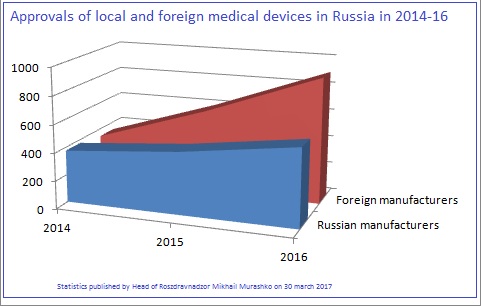
    At the end of March 2017, Russian medical device regulator Roszdravnadzor published statistics on registration of medical devices for the year 2016. It was reported that 1,465 new medical devices had been approved (which is around 40% higher than the year before) – among them 559 (38%) products manufactured in Russia and 906 (62%) by foreign manufacturers.

    Statistics on MD 2016.jpg
    According to the report, the number of registration refusals decreased by around 9% compared to the year before: the regulator reports 477 refusals with a similar ratio: 163 (34%) for local and 314 (66%) for foreign manufacturers. Roszdravnadzor evaluates the total number of registration refusals for the year as 15.2%.


  1. Quality Management System Inspections in Kazakhstan

    On 3 April 2017 the Kazakh medical device regulator (the National Center for Expertise) published a memo (link in Russian) for medical device and pharmaceutical manufacturers clarifying the rules for organising quality management system (QMS) inspection for registration of medical devices and pharmaceutical products. According to the document, for medical device manufacturers QMS inspection is mandatory if a legal manufacturer has never been registered in Kazakhstan before or manufacturing facilities have not been registered in Kazakhstan before, or in cases when conducting an analytical examination is impossible due to the lack or high cost of product samples. The regulator reminds us that the decision about inspection can be taken at any time during the examination. The inspection is carried out within 2-5 working days on one manufacturing site. Valid ISO standard certification of the manufacturer is a necessary condition for the inspection. The Kazak regulator highlights that the manufacturer should: organise the inspection within 30 days after receiving official notification; pay all costs associated with the procedure; and provide translation of necessary information into Russian.


Thank you for following this blog! My objective here is to make Russian and Eurasian medical device regulations clearer. You can also follow my updates on Twitter @MedDevRus