
Three Things You Should Know About Medical Device Regulations in Russia, July 2017


 Dear Colleagues and Group Members,

Welcome to my summer update, with my usual selection of highlights for medical device regulatory professionals who are interested in what is going on in Russia and the Eurasian Economic Union:


  1. Will New GMO Regulations Affect Medical Devices?

On 1st July 2017, rules for the mandatory state registration of genetically modified organisms (GMO) and products containing such organisms came into force in Russia.

Initially introduced by Government Resolution No. 839 (link in Russian) in September 2013, these rules were modified at the end of June 2017 by Resolution No. 770 (link in Russian). The scope of these rules was narrowed down for GMO “intended for release into the environment” only, and at the same time medicinal products and medical devices were excluded from the scope of these rules.

For today, paragraph four of the newly implemented rules underlines that GMO products containing medical devices must be registered within the framework of the established existing medical device registration procedure.

Thus, according to the current legislation for today, medical devices containing GMOs de jure will not require any separate or additional state registration procedure. It is not yet clear, however, if in practice it affects more detailed investigations of medical devices containing genetically modified cells or its products.

GMOs are currently used to produce components of multiple medical products, e.g. recombinant vaccines, clotting factors to treat haemophilia, human growth hormones, recombinant insulin, components of some in-vitro reagents, etc.


  1. Deadline for Submitting Applications on Prices for Implantable Devices

On 14th July 2017, the deadline passed for medical device manufacturers to submit applications to Roszdravnadzor (Russian healthcare regulator) for the state registration of the maximum selling prices for implantable medical devices.
In this framework, two databases have been recently published on Roszdravnadzor’s website:

  • The database with information on average prices for medical products classified according to Russian nomenclature classification (link in Russian).
  • State register of maximum sales prices for implantable medical devices included in the list of medical products for the programmes of state guarantees of free medical care to citizens (link in Russian).

The procedure for the regulation of prices for implantable medical devices was approved and has been developed by the Russian government since 2015. According to Resolution No. 1517, the price offered by the manufacturer cannot exceed the weighted average selling price, which is calculated by Roszdravnadzor.


  1. Eurasian Registration – Requirements for Electronic Submission

On 30th June , the Eurasian Economic Commission published Decision No. 78, “On Requirements for the Electronic Form of Applications and Documents of the Registration Dossier Submitted for Registration of Medical Devices” (link in Russian). The document defines requirements for the structure of the registration file for electronic submission, and rules for the completion of documents in electronic form submitted by the applicant to authorised Bodies of the Member States for registration of medical devices.

As of the end of July 2017, there is still no information that the medical device registration process according to harmonised Eurasian rules is working, whereas most of the Eurasian regulations have been formally enforced.
Three Things You Should Know About Medical Device Regulation in Russia and CIS, June 2017


Dear Colleagues and Group Members,

This is a monthly update with my selection of highlights for June 2017 on medical device regulation changes across Russia and CIS:

 1. Ukraine Completely Switched to New Medical Device Approval System

1 July 2017 is the end of the transition period from the system of state registration of medical devices to the assessment of conformity with Ukrainian Technical Regulations No.753, No. 754 and No.755.
After this date, medical devices approved under the “old” procedure that were put onto the Ukrainian market before this date will be allowed for distribution without passing the conformity assessment procedure and without a conformity mark. According to new regulations, these products will be allowed to be on the market before the end of their shelf lives, but not for more than five years from the date of their introduction into circulation.

The new Ukrainian medical device approval system is currently very similar to the European medical device and In-Vitro Diagnostics (IVDs) approval process, however the CE mark itself does not entitle a product to be placed on the Ukrainian market without meeting the requirements of local technical regulations.

The new Ukrainian medical device conformity assessment procedure is defined depending on safety class. The most common ways of assessment today include audits of manufacturing sites or batch conformity assessments. Low-class medical devices are mostly self-declared.

Other important requirements of the new approval system include the mandatory appointment of authorised representatives of manufacturers in Ukraine and mandatory use of  Ukrainian language on the product labelling.

At the end of June 2017, the Ukrainian state register of medical devices contained 3764 approved devices, while the website of the Ukrainian Ministry of Health listed 13 accredited notification bodies for medical devices and eight notification bodies for IVDs.


2. Deadline for Price Registration for Implantable Devices in Russia
Another important date on the Russian regulatory landscape is 15 July 2017 – this deadline was set by Resolution 1517 (link in Russian) for manufacturers of implantable medical devices and their authorised representatives to submit documents to Roszdravnadzor, the Russian healthcare regulator, for the registration of maximum sale prices for implantable medical devices included in the list for the programme of state guarantees for free provision of medical care (link to the last version of the list in Russian). A list of documents for price registration is defined in Clause 4 of the price registration rules (link in Russian). According to these rules, with proper preparation of the documents, a decision on the price registration should be taken by the regulator within five business days. Meanwhile, in June 2017 the Russian regulator started publishing information about “average-weighted” prices agreed with the Russian Federal Anti-Monopoly Service (FAS). Published prices were provided using a Russian nomenclature classification system.

3. Further Development of the Eurasian Medical Device Regulation Model

After the formal entry of documents at the second level of the Eurasian harmonised system for regulating the circulation of medical devices came into force in May 2017, this system continues to develop. Thus, in June 2017, the Eurasian Commission published drafts of a number of new third-level documents:

  • On the classifier of the types of adverse events associated with the use of medical devices (link in Russian)
  • On the classifier of kinds of documents of the registration dossier on a medical device (link in Russian)
  • On the nomenclature of medical devices (link in Russian)
  • On the Consultancy Committee on Medical Devices (link in Russian).

From today, documents are available as drafts, which remain under public discussion status until the end of July.


*****

I would like to thank IMPROVE MEDICAL for providing updates on the development of Ukrainian medical device regulations. The IMPROVE MEDICAL conformity assessment body is based in Kyiv and performs conformity assessment with Ukrainian technical regulations for medical products.

You can also follow my news subscription on this page or on Twitter @MedDevRus


Three Things You Should Know about Medical Device Regulations in Russia and the Eurasian Union, May 2017


Dear colleagues and group members,


Here is May’s monthly newsletter, showing a selection of medical devices and regulatory highlights for Russia and the Eurasian Union.


  1. Developments in Eurasian Economic Union (EAEU) Medical Device Regulation

“On May 6, 2017, the main regulation acts of the EAEU, ensuring the functioning of the common markets for medicines and medicines, are coming into force” –this statement was made  by the Minister of the Eurasian Economic Commission, Valery Koreshkov, at the very beginning of May. Thus, ten days after the ratification of the protocol on Armenia’s accession by the Kyrgyz Republic, most of the ‘‘second level’’ documents regulating the circulation of medical devices in the single market of the Eurasian Economic Union came into operation. The thirteenth and last ‘‘second level’’ document on the requirements for the quality management system (QMS) has not yet been adopted or entered into force. However, this is not likely to be an obstacle to the launch of a single medical device market.

Later, on 24 May 2017, the Eurasian Commission published the first draft of “third-level” regulations – recommendations on a list of applicable standards to ensure compliance with essential principles of safety and efficacy of medical devices in the EAEU (link in Russian). The document contains a list of 43 standards (mostly Russian GOSTs and Belorussian STBs) which may be voluntarily used by manufacturers and testing laboratories of member states to demonstrate conformity with new Eurasian medical device regulations. The Eurasian Commission recommends that member states implement the list gradually, within six months from the day of its official publication.

In addition to this, Russian healthcare regulator Roszdravnadzor announced an upcoming one day seminar and webcast on the registration of medical devices in accordance with the changes in the legislation of the EAEC. This will take place in Moscow on 8 June 2017. The agenda of the seminar also covers topics relating to clinical trials, vigilance requirements and implementation quality management systems according to EAEU requirements.

  1. Medical Device Nomenclature in Kazakhstan

On 22 May 2017, the Ministry of Health of Kazakhstan approved new nomenclature of medical devices harmonised with the Global Medical Device Nomenclature (GMDN) together with the Methodological Guidelines for the Formation and Maintenance of the Nomenclature of Medical Devices of the Republic of Kazakhstan. Nomenclature of medical devices may be used for registration, traceability, public procurement and post-registration control for medical devices. New medical device nomenclature is available online (link in Russian) and contains a list of medical devices, including their names, relevant codes and descriptions of their types, as well as classification characteristics used for search and classification.

  1. Russian Regulator Updates Checklist for Control Inspections

At the end of April 2017, Russian healthcare regulator Roszdravnadzor published its order #4043 (link in Russian) and updated the “list of regulations containing mandatory requirements, the observance of which is assessed in the course of state control”. The abovementioned list replaced the previous version published by the regulator in November 2016 (Order #12848). Section three of the published list is devoted to state control of medical devices and summarises the full list of applicable regulations which is assessed by Roszdravnadzor during audits and inspections of manufacturers of medical devices and medical facilities in Russia.


***

The objective of this blog is to clarify Russian and Eurasian regulations. Please post your comments and questions here or on the Russian medical device regulations LinkedIn group. You can also follow me on Twitter @MedDevRus.

Three Things You Should Know about Medical Device Regulations in Russia and the Eurasian Union, April 2017

Dear colleagues and group members,

Welcome to my usual update on medical device regulations in Russia and countries of the Eurasian Economic Union (EAEU). Here are my three highlights for April 2017:

  1. Lifting Political Barriers for the Launch of Eurasian Economic Union Medical Device Regulations

    On 5 April 2017, the Kyrgyz Republic endorsed a law “On Ratification of the Protocol on Accession of the Republic of Armenia to the Agreement on Common Principles and Rules for the circulation of medical products within the EAEU”. According to the provisions of the Protocol, Armenia officially joins the above Agreement. Until this date, ratification of this Protocol was one of the main political factors hampering the full launch of the unified medical device market and regulatory model for EAEU countries. The law entered into force ten days after the day of its official publication.

    In this way all the obstacles to beginning the work of a unified pharmaceutical and medical device market have been lifted and all the second-level EAEU medical device regulations (except the quality management system requirements which are not released by the Eurasian Commission yet) are de jure coming into force for all EAEU member states.

    It will be recalled that in recent months official fees for the registration of medical devices according to the new Eurasian procedure were published in Russia, Belarus and Armenia.


  1. Statistics on Medical Device Registration in Russia

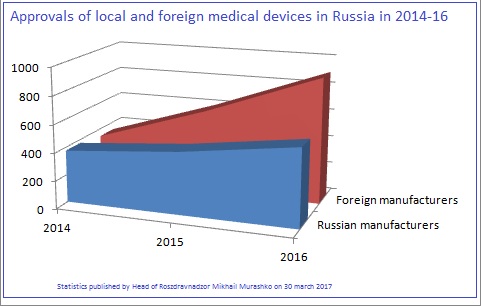
    At the end of March 2017, Russian medical device regulator Roszdravnadzor published statistics on registration of medical devices for the year 2016. It was reported that 1,465 new medical devices had been approved (which is around 40% higher than the year before) – among them 559 (38%) products manufactured in Russia and 906 (62%) by foreign manufacturers.

    Statistics on MD 2016.jpg
    According to the report, the number of registration refusals decreased by around 9% compared to the year before: the regulator reports 477 refusals with a similar ratio: 163 (34%) for local and 314 (66%) for foreign manufacturers. Roszdravnadzor evaluates the total number of registration refusals for the year as 15.2%.


  1. Quality Management System Inspections in Kazakhstan

    On 3 April 2017 the Kazakh medical device regulator (the National Center for Expertise) published a memo (link in Russian) for medical device and pharmaceutical manufacturers clarifying the rules for organising quality management system (QMS) inspection for registration of medical devices and pharmaceutical products. According to the document, for medical device manufacturers QMS inspection is mandatory if a legal manufacturer has never been registered in Kazakhstan before or manufacturing facilities have not been registered in Kazakhstan before, or in cases when conducting an analytical examination is impossible due to the lack or high cost of product samples. The regulator reminds us that the decision about inspection can be taken at any time during the examination. The inspection is carried out within 2-5 working days on one manufacturing site. Valid ISO standard certification of the manufacturer is a necessary condition for the inspection. The Kazak regulator highlights that the manufacturer should: organise the inspection within 30 days after receiving official notification; pay all costs associated with the procedure; and provide translation of necessary information into Russian.


Thank you for following this blog! My objective here is to make Russian and Eurasian medical device regulations clearer. You can also follow my updates on Twitter @MedDevRus

Seven Questions about Authorized Representative in Ukraine

After the entry into force of new medical device regulations in the Ukraine, foreign manufacturers were faced with a number of procedural questions. One of these questions is about the authorized representatives (AR) functions, powers and duties.
Improve Medical – the conformity assessment body based in Ukraine kindly agreed to clarify most actual aspects about AR. Let’s have most frequent questions answered in this post:

  1. Who may be the authorized representative for foreign medical device manufacturers in Ukraine? 

    According to of the Technical Regulations (cl. 2.13) the AR in Ukraine may be:

    • legal person – a  resident of Ukraine;
    • natural person with status of an entrepreneur, a citizen of Ukraine;
    • representational office of foreign manufacturer of medical devices in Ukraine;
    • distributor of foreign manufacturer of medical devices in Ukraine.
  2. What documents are needed for the AR to undertake these obligations?
    AR is appointed on the basis of an agreement (contract) or an arrangement in which it is necessary to specify duties and functions to be undertaken by the AR. As a rule these functions are as follows:

    • to initiate on behalf of the manufacturer the assessment of the conformity to the Ukrainian technical regulation and to the QMS;
    • to perform all related payment;
    • to provide translation of technical documentation;
    • to prepare package of documents for assessment procedures;
    • to obtain certificates of conformity assessment from the certified bodies;
    • to store the technical documentation and all certificates;
    • to report to the manufacturer about adverse events/side-effects, found out as the result of the use of his products;
    • to inform potential customers about technical and consumer properties of the manufacturer’s products;
    • to inform the manufacturer about the amendments in Ukrainian regulations.

    The right of the AR to reassign to the third parties the powers given to him by the manufacturer shall be also stipulated – but along with this, the AR bears the responsibility for actions of the third parties as for his own.The validity period of this contract is usually determined as not less than five years.

  3. What functions shall perform the Authorized representative? 

    The main function of the AR is the representation of interests of foreign representative in the territory of Ukraine and communication between the foreign manufacturer of medical products and Ukrainian market. It shall be understood however, that the term «Ukrainian market» means not so much marketing outlet itself, as bodies of assessment of the conformity, monitoring bodies, fiscal bodies etc. All functions, which the manufacturer assigns to his AR in Ukraine, should be stipulated in the contract.

  4. Is it necessary to sign a contract if the manufacturer assigns functions of the AR to his representational office or to the distributor? 

    If the Ukrainian party, according to the acting contract, has not powers of the AR, it is necessary to either issue the power of attorney, or conclude a separate contract or additional agreement to the acting contract.

  5. What risks are the most typical for manufacturer and AR? 

    Basic risks, as a matter of fact, are equal both for the manufacturer, and for his AR: Most commonly It is delays or failed procedure of the conformity assessment procedure which may postpone introduction of the medical product into the market, but also to cause  penal sanctions on the manufacturer and his AR by the controlling bodies. Therefore the AR should make the choice of the body of assessment of the conformity of medical products to the Technical regulations extremely prudently.

  6. What about termination of the contract with AR?

    Reasons for the termination of the contract should be stipulated in the contract. It should be, as a rule, non-fulfillment or improper fulfillment of the contractual obligations by the parties or the force-majeure circumstances. Usually the termination of the contract with AR shall not oblige the manufacturer to withdraw from the market the products put into the circulation (its lot), change its packing and undergo the procedure of the assessment of the conformity to the Technical regulations once more.
  7. May one authorized representative render services to several manufacturers of medical products? 

    Yes, it is possible and not prohibited by Ukrainian law. In this case the AR should, as a rule, notify all manufacturers, whose products he represents in Ukraine.

*****

The answers were provided by IMPROVE MEDICAL – Conformity assessment Body which performs  conformity assessment with the Ukrainian technical regulations (regulations #753, 754, 755) for medical devices, active implantable medical devices and in vitro diagnostics.

Three Things You Should Know about Medical Device Regulations in Russia and the Eurasian Union, March 2017.


Dear Colleagues and Group Members,

Welcome to my monthly update on the latest news on medical device regulations in Russia and the Eurasian Economic Union. Here are three of the most important updates for March 2017:


  1. Russia Released Requirements on Technical Files and Instructions for Use of Medical Devices


On 15th March 2017, the Russian Ministry of Health released Order #11N (link in Russian) with a list of requirements for technical files and instructions for use of medical and in-vitro devices (IVD). Undoubtedly, this is one of the most important and long-awaited Orders concerning medical device regulations issued in Russia in the last few years. Since the Russian medical device regulation system changed in 2013, information on the structure of technical documentation was available only as recommendations or voluntary standards, which could be interpreted differently by different institutions. This was one of the most common sources of a lack of understanding of registration requirements and subsequent registration delays.


The new requirements became effective from 24th March 2017. Since this date, manufacturers have had to ensure that technical files in registration dossiers for medical devices contain 20 mandatory clauses/chapters (and seven additional clauses for IVD products). Meanwhile the structure of so-called “operational documentation” (i.e. instructions for use (IFU) /product inserts/user manuals) must contain 21 clauses/chapters for all medical devices, with 19 additional clauses for IVD products.


As this regulation is relatively recent and no additional guidance has been published, it is difficult to assess the impact at this stage, but it should be noted that some requirements are quite new, for example, one of the requirements for IFU is to provide “the list of data, keys, passwords, and software necessary to mount, set up, operate, and maintain the medical device provided by the manufacturer” (see clause 11g) or to include “the list of national <i.e. Russian?> standards applied by the manufacturer” (see clause 11h).


I will closely follow the development of this topic in my blog and publish an analysis of new requirements relating to any additional guidance in future posts of this blog.


  1. Consulting on Russian Medical Device Registration Procedure


Following Resolution #160 published last month which (among other initiatives) provided the possibility of official consultations on the medical device registration process on behalf of Russian regulatory expert centres, in March 2017 Roszdravnadzor (the Russian medical device regulator) published the draft regulation with a detailed description of the future consultation procedure. According to the document, consultancy will be performed by two Russian expert organisations involved in the registration process, namely VNIIMT (ВНИИМТ) and CMKEE(ЦМИКЭЭ). Consultations could cover registration and re-registration procedures, question classification of medical devices according to Russian regulations and could be carried out by answering questions posed by applicants, both in oral and written forms.

During consultations, experts cannot perform preliminary assessments of a dossier and cannot cover questions regarding expert evaluation.
A consultancy meeting should be scheduled based on the contract between an applicant and expert centre, and should occur within thirty days of receipt of the applicant`s request for a meeting.

The cost of consulting services and their schedules will be determined by each expert centre.


  1. Reporting Adverse Events in Belarus


In March 2017, the Belorussian Ministry of Health clarified its requirements for reporting adverse events for manufacturers of medical devices. According to a letter released on 17th March 2017, the following information must be reported: “serious or unexpected side-effects not mentioned in the instructions for use <of a medical device>, all adverse events during its usage/exploitation, peculiarities of interaction with other medical devices” to include facts of substandard quality and circumstances creating a threat to life and health of patients and medical personnel”. In the same letter, the regulator provided a form for manufacturers or distributors to use for reporting events and warned about responsibility measures in case of potential violations.


***

My blog is a non-commercial project aimed to make Russian and Eurasian medical device regulations clearer. I would like to remind that you can get my updates directly via e-mail by using the “Follow” button on the toolbar of this page.

Russia updated requirements for technical file and instruction for use for medical devices

On 15 March 2017 the Russian Ministry of Health released the Order #11N ( link in Russian) with full list of requirements for technical file and instruction for use for a medical and in-vitro devices.
It is the first time when these requirements is published as official regulation – until today they were available only as recommendation or voluntary standard, which different interpretation was one of the most common reasons of registration delays.
According to the document the requirements are applicable both for registration and for other stages of a medical device life-cycle.

Three Things You Should Know about Medical Device Regulations in Russia and the Eurasian Union, February 2017.

Dear Colleagues,

Welcome to my monthly update on medical device regulations in Russia and countries of the Eurasian Economic Union (EAEU). Here are my three highlights for February 2017:


  1. Prolongation of old forms for registration certificates

    On 14 February 2017, the Russian government released the Resolution 160 (link in Russian).
    The key update on this resolution is prolongation of the deadline for the procedure of administrative replacement of “old” forms of Russian medical device licences issued before 2013.

    Recall that, according to the Resolution 1416 of the Russian government issued at the end of 2012, registration certificates for medical products and medical equipment issued before the date of entry into force of the new registration rules (2013) were to be replaced under a special administrative procedure. Initially, entry into force of the measures was planned for 1 January 2014 and then was postponed until 1 January 2017.

    The Resolution 160 extends these deadlines again for another four years – until 2021, in line with the end of the transition period for Eurasian medical device regulations.

    Russian medical device regulator Roszdravnadzor says more than 10,000 registration certificates were replaced using this procedure from 2013 till 2016. Meanwhile from the other side industry experts assess that up to 10% of licences for medical devices on the Russian market were not updated on time.

    The formal timelines for the administrative replacement procedure according to the Russian regulations is 30 business days; the process for application is described here.


  1. Official consulting from Russian medical device regulatory authorities

    Another innovation introduced by the Resolution 160 is the possibility for official consultations on the medical device registration process on behalf of Russian regulatory expert centres involved in the registration process. The resolution addresses Russian medical device registration rules with relevant amendments (see clause 58.1), allowing medical device manufacturers to discuss with authorities specific aspects of the regulatory process and requirements.

    Recall that previously, Russian law did not allow such forms of consultancy, and direct communication between manufacturers and authorities on any specific question was prohibited.

    Considering that lack of transparency still remains one of the key challenges for regulatory professionals in the Russian medical device registration process, such possibility could be especially valuable for medical device manufacturers in the near future.


  1. Fees for Eurasian medical device registration procedure

    On 22 February 2017, the Russian Duma released a draft federal law aiming to update the Russian tax code. Among other updates and amendments, the document introduces long-awaited information about amount of fees for a harmonized Eurasian medical device registration procedure.

    The total proposed registration fee for a medical device consists of three parts:
    a) Constant registration fee: 7,000 roubles (approx. 120 USD)*
    b) Fee for the expertise: 45,000–115,000 roubles (750–1,800 USD)* depending on safety class
    c) Fee for the “acceptance” procedure: 45,000–115,000 roubles (750–1,800 USD)* depending on safety class for each member state.

    Today, lack of established fees for registration is one of the reasons why a harmonized EAEU medical device regulation model is still not working in practice. One can expect that proposed amendments will come into force from the second half of 2017 after approval of both chambers of the Russian parliament.

                 *RUR/USD rate provided for end February 2017
***

The objective of this blog is to make Russian and Eurasian regulations clearer. Please post your comments and questions here or on the  Russian medical device regulations LinkedIn group.


Deadline for Replacement of “Old” Licences Extended

On 14 February 2017, the Russian government published the Resolution #160 (link in Russian) and extended by the 1 January 2021 the deadline for the administrative replacement of the Russian medical device registration certificates issued before 2013.

According to some experts for today from 4000 to 14000 medical devices on the Russian market have “old” form of licences.

The deadline for the replacement is harmonized with the end of validity of registration certificates according to upcoming Eurasian medical device regulation.


Three Things You Should Know about Medical Device Regulations in Russia, January 2017

Dear Colleagues and Group Members,

This is a monthly update with my selection of highlights at the end of January on medical device regulation changes across Russia:

1. Cancellation of “old” forms of Medical Device Registration Certificates.
On 1 January 2017, Russia applied a deadline for the replacement of old forms of registration certificates for medical devices. Despite the fact that this deadline was set and became known four years ago, and the administrative procedure of the replacement was relatively simple (compared to the registration process), several sources have reported a number of cases when medical device companies did not replace their licences in time and for this reason, shipments of products into Russia during the first days of 2017 were stopped. To date, no statistics about the numbers of replacements have been officially published.
The question today is about the regulatory status of medical devices with old forms of “non-replaced” registration certificates which had already been imported into Russia before 2017 – it is unclear if such products can be legally commercialised.
At the same time, it is known that a possible extension of this deadline until 2021 has been suggested, together with other amendments under the current medical device registration rules in Russia. These are now still under the consideration of the Russian government. At the end of the day 30 January, the decision on this consideration has still not been published, so today still such scenario is not excluded.

2.New List of Medical Devices with 0% Value Added Tax
In the first days of January 2017, the Russian government published Resolution #1518 (link in Russian), which amended the list of medical products which were not subject to value added tax (VAT) in Russia. The previous version of the list was published in October 2015.
The new version of the list (link in Russian) contains 45 types of medical products separated into three parts: medical devices, optical lenses and rehabilitation equipment. Medical devices are classified using both “old” all-Russia Product Classification – OKP (for medical devices registered before 2017) and “new” OKPD-2 classification systems.
It should be recalled, that according to articles 149 and 150 of the Russian Tax Code (link in Russian), imports of registered medical devices to Russia should be exempted from VAT in distinction of 10% or 18% for other (medical) products.

3.Request to Report Data for Implantable Medical Devices
At the end of December 2016, the Russian medical device regulator Roszdravnadzor released a letter (link in Russian) aimed at manufacturers of implantable medical devices in Russia and requested them to report data, together with providing customs and finance documentation, for the period from 1 January until 31 December 2016 for the purpose of calculating “weighted-average” prices for each type of implant included in the list of medical devices subject to state healthcare programmes (link in Russian). According to the document, information should be reported using an electronic system, together with hard copies, by 15 March 2017.
The price regulation of medical devices from the list was set in Resolution #1517 at the end of 2015, but the deadline for its implementation has been postponed until the middle of 2017.

Thank you for following this blog! My objective here is to make Russian and Eurasian medical device regulations clearer. You can also follow my news on Twitter @MedDevRus