One Year to Replace “Old” Registration Certificates.

Why?

According to clause #2 of Russian Medical Device Registration Rules (Resolution 1416):

Medical device and medical equipment registration certificates with an unlimited validity period, issued before the effective date of this Resolution, shall be valid until and be replaced on January 1, 2017, with registration certificates in the format approved by the Federal Service for Healthcare Supervision (Roszdravnadzor).

A registration certificate shall be replaced without the repeated state registration of medical devices, on the basis of the application submitted by the applicant to the Federal Service for Healthcare Supervision and containing the information envisaged in the Rules provided for by this Resolution.

Does my certificate need replacement?

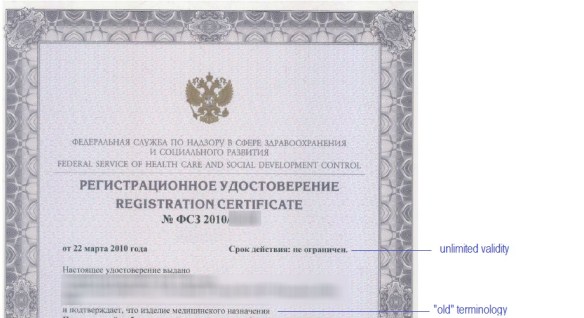
How does registration certificate with an unlimited validity period look like (need replacement by 01.01.2017):

old registration1

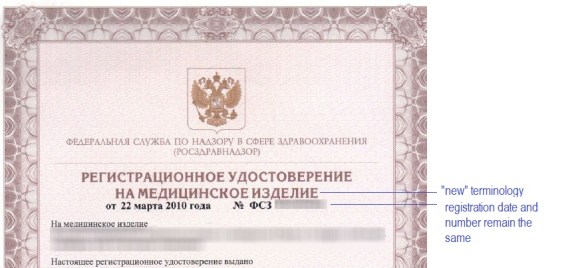
How does new format registration certificate look like:

new registration1

What is the process?

  1. Sign the Power of Attorney/Autorization letter in the name of Russian Autorized Representative (legalization with apostile is required).
  2. Complete the application form;
  3. Submit the file to Roszdravnadzor (1+2+a scan copy of “old” certificate);
  4. Review time 2-4 weeks (for Q4 2015);
  5. Return paper copy of “old” certificate and get the new one.

Three Things You Should Know about Medical Device Regulations in Russia and the Eurasian Economic Union, November 2015

Is it the calm before the storm? In November 2015 we cannot observe major regulatory news and updates for medical devices in Russia and the Eurasian Economic Union countries… In one month’s time the common harmonised market of pharmaceuticals and medical devices will begin functioning (at least formally). Meanwhile, at the current time, there are still a lot of questions to be answered, second-level regulations and guidelines to be published…
Nevertheless, here are some updates which should be useful to know for your Russian regulatory projects:

  1. New version of national standards for labelling requirements for In Vitro devices

In November 2015 the Russian Federal Agency on Technical Regulating and Metrology (Rosstandart) published an updated version of its voluntary national standard GOST R ISO 18133, which is composed of five parts and which contains technical requirements on labelling and accompanying information and documentation for In Vitro Diagnostic (IVD) medical devices (part 1, link in Russian), IVD reagents (part 2, link in Russian), IVD instruments for professional use (part 3, link in Russian), self-testing IVD devices (part 4, link in Russian), and IVD instruments for self-testing (part 5, link in Russian). The new standard will come into force in November 2016 and will replace the version from 2009, which is valid currently. It should be recalled that the use of standards is voluntary, but recommended by Roszdravnadzor as the best way to demonstrate that a medical device meets all labelling requirements during the approval process and into further commercialisation.

  1. Discussions around the Russian product classification code
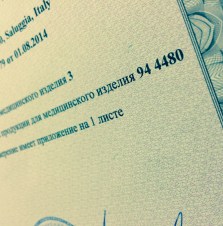
FullSizeRenderAnother update from the Federal Agency on Technical Regulating and Metrology (Rosstandart) is the extension of validity of the Russian product classification code OKP (ОКП ) until 1 January 2017. The OKP code is a classification code which is present in every registration certificate (in addition to the medical device safety class and nomenclature classification) and is used by customs officials, among others, to define the amount of VAT exemption during medical device import and customs clearance. Previously, the deadline for transition into a new product classification system was set as 1 January 2016, which seemed to threaten a wave of uncertainty in calculation and in applying VAT exemption in practice. It should also be noted that some months ago Roszdravnadzor (the Russian medical device regulator) expressed the opinion that, in future, this code should be removed from the registration certificate.


  1. Armenia joins the EEU Agreement for Medical Devices

ArmeniaArmenia ratified the Agreement on common principles and rules of circulations of medical devices signed at the end of last year by EEU countries. In such a way, for November 2015, this agreement is approved by Russia, Belarus, Kazakhstan, Kyrgyzstan, and Armenia. It should be noted that, at present, unlike in other EEU countries, Armenia regulates the approval process for pharmaceuticals and not medical devices, which suggests quite deep further changes are coming in the medical device sector for the country.

In conclusion, I would like to thank you for the following and remind that you can get regulatory updates about Russian medical device regulations from this blog directly in your e-mail using the ‘Follow’ button in the toolbar in the upper corner of this page.

Classification of In-Vitro Diagnostic (IVD) products in Russia

Classification of In-Vitro Diagnostic (IVD) products in Russia is based on similar (but not the same!) principles as described in GHTF/SG1/N045:2008 guidance. Classification rules are described in the Decree of the Ministry of Health #4N (Link in Russian) and more detailed specific national standard GOST R 51088-2013 (link in Russian).  Please note that in addition to classification based on safety class there is nomenclature classifier (link in Russian) which should be considered when IVD is submitted for registration. Please find my summary in the slide below:

Three Things You Should Know about Medical Device Regulations in Russia, October 2015

Dear colleagues,

Welcome to my monthly update, in which I share the latest news and updates on medical device regulations in Russia and countries of the Eurasian Economic Union (EEU). Here are my three highlights for October.

 1. The Russian government approved the list of medical products subject to value-added tax exemption.

In the first days of October 2015, the Russian government published resolution #1042 (link in Russian) and approved the list of medical products, which are not subject to value-added tax (VAT). The list consists of three parts: medical devices, optical devices and rehabilitation equipment. Resolution #1042 placed the period in long-lived contradictions between tax and customs legislation for medical devices in Russia. According to article 150 of the Russian Tax Code, imports of medical devices to Russia should be exempted from VAT. However, for several years this rule was a source of controversy for Russian customs, which imposed extra VAT (18% instead of 0%) in some cases due to new terminology for medical devices implemented by the Federal Law #323 in January 2013.

  1. Kazakhstan implemented new fees for the registration of medical devices.

On 22 October 2015, the Ministry of Health of Kazakhstan enforced resolution #771 (link in Russian), implementing new rules for the calculation of fees for the expertise of medical devices for the state registration. New fees are provided for different classes of medical devices and are calculated based on safety class and number of modifications of the device or number of units in the kit in one submission. For example, the minimal fee provided for registration of a simple, low safety class medical device for dentistry is calculated as 48,000 KZT (about 170 USD) per unit; the highest fee of 515,000 KZT (about 2,000 USD) is provided for complex capital equipment.

  1. Eurasian medical device session of the National Annual Regulatory Conference.

Less than two months remain until the enforcement of the Agreement on common principles and rules of the circulation of medical products of the Eurasian Economic Union. A special session of the Annual National Regulatory Conference, FarmMedObrashenie, was devoted to this topic on 19 October 2015, where a representative from the Eurasian Economic Commission made a report on the status of second-level regulations to this agreement. It was reported that no final regulations have yet been published and all documents (thirteen in total) are currently still in ‘a high state of readiness’. All drafts are available online. Possible changes ‘will be of an administrative nature’ only and the final regulations are stated to be enforced ‘in very similar editions’.
Representatives from Roszdravnadzor (Russian medical device regulator) expect that ‘in order to avoid a repetition of the painful Russian experience of 2013’, with high probability during the transitional period imposed in chapter 11 of the Agreement, it will be possible to work on two parallel procedures: the local registration procedure of the country (effective today) and a new procedure of the Eurasian Union. Please see detailed Q&A on this topic in the separate post.

The objective of this blog is to make Russian and Eurasian regulations clearer. Please post your comments and questions here or on the Russian medical device regulations Linkedin group You can also follow me on twitter @MedDevRus.

Five Questions on Eurasian Medical Device Integration on the Annual National Regulatory Conference

FMO 20151019Less than two months remain until the enforcement of the Agreement on common principles and rules of the circulation of medical products of the Eurasian Economic Union. A special session of the Annual National Regulatory Conference, FarmMedObrashenie, was devoted to this topic on 19 October 2015, where a representative from the Eurasian Economic Commission made a report on the status of second-level regulations to this agreement. It was reported that no final regulations have yet been published and all documents (thirteen in total) are currently still in ‘a high state of readiness’. All drafts are available online. Possible changes ‘will be of an administrative nature’ only and the final regulations are stated to be enforced ‘in very similar editions’.

Representatives from Roszdravnadzor (Russian medical device regulator) expect that ‘in order to avoid a repetition of the painful Russian experience of 2013’, with high probability during the transitional period imposed in chapter 11 of the Agreement, it will be possible to work on two parallel procedures: the local registration procedure of the country (effective today) and a new procedure of the Eurasian Union.

Here there are five questions on Eurasian medical device integration answered by Roszdravnadzor.

Question: If a medical device is registered in Russia today, will it be approved for whole Eurasian Economic Union after 1 January 2015?
Answer: No. All medical devices approved in member states according to local procedures remain approved only in the country of registration. For approval in the whole of the Eurasian Economic Union, medical devices must pass through the new EEU registration procedure.

Question: A registration file will be submitted 31 December 2015. Using which procedure will the medical device be registered?
Answer: In this case, the medical device will be registered under the local registration procedure of the member state.

Question: During the transition period, will the applicant have a right to choose which procedure to use (the new EEU procedure or the old local procedure)?
Answer: Yes, during this period it is now expected that the applicant will able to choose between the procedures.

Question: Will a medical device require the new EAC-med symbol for the EEU after 1 January 2016?
Answer: The new EAC-med symbol will be required for medical devices approved under the new EEU registration process. Medical devices approved under local procedures of member states do not need the EAC-med symbol.

Question: As was previously required, all Russian registration certificates must be replaced by 2017. Will enforcement of the new EEU regulations cancel this requirement?
Answer: No, all Russian registrations with unlimited validity issued before 2013 must be replaced by 1 January 2017 under a special administrative procedure. Roszdravnadzor will continue these replacements in 2016.

Этот пост по-русски

Russian Government Approved the List of Medical Goods Subject to VAT exemption (0% VAT)

The resolution #1042 is available on the website of Russian Government (link in Russian).

According to Russian legislation, (duly registered) medical devices have VAT preferences for importation and commercialization within the country (0% or 10% instead of 18% VAT). In this context it should be recalled, that The Federal Law # 323 came into force on 1st of January 2013 and unified terminology on medical products what made confusing VAT applicability.  Changes in the Russian Tax Code in November 2013 and Government Resolution #870 (link in Russian) in September 2014 made the situation clearer nevertheless the issue has not been totally solved and have been remaining  the source of controversy to apply for Russian customs.

Three Things You Should Know about Medical Device Regulations in Russia and CIS – September 2015

Dear colleagues,

This is my monthly update on what is happening in terms of medical device regulations in Russia, the Eurasian customs union, and CIS. As you probably remember, there are only three months left before the new, harmonised Eurasian regulations come into force in January 2016. Meanwhile, September was a rather quiet month in terms of surprises for Russia. Here are my highlights for the region:

  1. Will New Russian Law on Personal Data Affect the Medical Device Sector?

Let me start with highly debated and strategic legal initiative. On 1 September, Russia implemented amendments to Federal Law #152 (link in Russian) “on the processing of personal data in information and telecommunication networks”. The amendments require companies to store personal data about Russian citizens on Russian territory. The law broadly defines personal data as “any information relating directly or indirectly to an identified or identifiable natural person (the subject of the personal data)”. The provisions of the new law are not only strict, but the number of issues remain unclear – particularly for the medical device industry. How will this regulation affect medical device data systems, medical image storage devices, medical communications devices, or any other medical software (or hardware) that transfers, stores, and converts medical patient data, and medical records? How will this law be implemented in terms of data processing for clinical trials of medicines and medical devices? Could this regulation be left unimplemented in terms of medical devices? As you see, there are a number of unanswered questions and nuances that need to be clarified in the coming months.

  1. Changes in the Registration Procedure for Kazakhstan

The Ministry of Health of Kazakhstan has enforced changes to the procedure of registration of medical devices. The new rules have been approved and published in decree #524 (link in Russian). The Kazak approval agency highlighted that the main changes to the procedure relate to the registration application form, which henceforth should be completed in either the Russian and Kazak language, it should contain a GMDN code (if applicable), and information about the prices of medical devices for further price monitoring. The changes also concern the list of documents required for the registration dossier (e.g. requirements in terms of legalisation and bilingual Russian-Kazak packaging design). The new rules have tightened the timeframes for an applicant to respond to additional inquiries from the approval agency after submission. Henceforth, if an applicant does not provide a response within thirty days, the registration could be formally rejected. It should be noted that the medical device registration procedure in Kazakhstan takes from 90 to 160 business days depending on safety class.

  1. Ukrainian Ministry of Health is Discussing the Prolongation of the Transitional Period for the New Approval process for Registered Medical Devices

In September 2015, the Ukrainian Ministry of Health circulated the DRAFT of the of the decree (link in Ukranian) suggesting the prolongation of the transitional period (until 1 July 2017) for the change to the new conformity assessment approval procedures for medical devices that was already registered in Ukraine before 1 July 2015. Previously this deadline was set as 1 July 2016. The document introduced additional requirements for devices imported in this period to be used within their operational period, but not for longer than five years. Meanwhile, for all non-resident medical device manufacturers, the establishment of an authorised Ukrainian representative remains mandatory for the approval and commercialisation of a medical device. As you will recall, since 1 July 2015 access for medical devices into the Ukrainian market must be subject to a new conformity assessment approval process that requires the acquisition of a special conformity mark.

Thank you for following the newsletter. I am always grateful for your comments and encourage you to ask specific questions in the group.

Alexey Stepanov
Alexey@MedicalDevicesInRussia.com
@MedDevRus