Unknown's avatar

About Alexey Stepanov

Medical Device Regulatory and Quality Professional based in Russia.

Three Things You Should Know about Medical Device Regulations in Russia and the Eurasian Economic Union, May 2016

Dear colleagues and group members,

Welcome to my monthly update on medical device regulations in Russia and countries of the Eurasian Economic Union (EEU). Here are my three highlights for May 2016:


  1. Development of the Eurasian Medical Device Regulations

In May 2016, the Eurasian commission published final approved versions of five second-level regulations (which were previously available as drafts) for the Agreement on Common Principles and Rules of Circulation of Medical Devices in the Eurasian Economic Union (EEU):

  • Essential principles and rules on the safety and effectiveness of medical devices (link in Russian) – this document was drawn up on the basis of similar GHTF guidance and provides general and fundamental design and manufacturing requirements on the safety, quality and performance of medical devices (MD) and in-vitro medical devices (IVD). In addition, this document provides common labelling requirements for MD and IVD within the Eurasian Economic Union
  • Rules on conducting technical testing for medical devices (link in Russian) and Rules on conducting clinical trials (link in Russian) provide guidance on conducting pre-submission testing and trials. Good news for IVD manufacturers – in contrast to the current Russian approval process, only clinical trials will be needed in the EEU (skipping the technical tests). Not so good news for implantable devices – full-scale clinical trials with patients’ involvement will be mandatory for their approval
  • Resolution on the EEU medical device mark (link in Russian) – this document provides detailed descriptions of new EAC (EEU) medical device symbols and procedures of EAC-marking for medical devices approved under the new harmonised approval process
  • Resolution on the formation and maintenance of the common medical devices information system (link in Russian), which describes procedures for the common Eurasian database of approved medical devices, clinical centres and laboratories accredited to conduct trials/testing and information on medical devices’ adverse reactions and safety field actions within the EEU.

In these ways, today the full Eurasian medical device regulatory model can be vizualized like this:
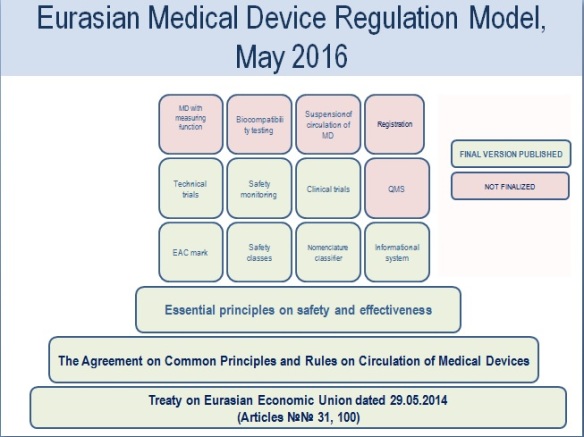
EEU 201605

Although currently the new EEU procedures do not work in practice, according to the Eurasian commission, a full-scale launch of the new harmonised system is expected in 2016.


  1. The Russian Ministry of Health is considering an extended list of Implantable Medical Devices
    The Russian Ministry of Health is preparing an extension of the “List of Implantable Medical Devices for Medical Aid Provided to Citizens under the Programme of State Guarantees of Free Medical Care“. According to information published in May 2016 (link in Russian), the Russian regulator reviewed 671 applications from medical device manufacturers and medical institutions, with positive decisions made on the majority of them.

    In this context, it should be recalled that the last version of the list (with 207 items) was published in December 2014. According to the Russian Ministry of Health, companies producing Implantable Medical Devices not included in the list will not able to participate in national healthcare programmes from 2017. According to current procedures, applications for inclusion in the list can be submitted to the Ministry of Health by 1st March each year.


  1. New Version of Guidelines for Expertise in Medical Devices
    A draft of new guidelines on the expertise in medical devices for procedures of registration was published in May 2016 (link in Russian). This document contains detailed descriptions of the expertise procedure, requirements on documentation format for registration and testing files, and unifies these requirements from two expert organisations. The document will replace the previous version of these guidelines (link in Russian) published in November 2013 and will be expected to come into force formally in the near future.

Thank you for following the blog and newsletter. I am always grateful for your comments and encourage you to ask specific questions in the LinkedIn group.

Three Things You Should Know about the Regulation of Medical Devices in Russia, April 2016

Dear colleagues and group members,

Let me share the latest news and updates on medical device regulations in Russia CIS and countries of the Eurasian Economic Union (EEU). Here are my three highlights from April 2016.


  1. Prolongation of the Transitional Period in Ukraine.

At the beginning of April 2016, the Ukrainian government published the text of Decree # 240 (link in Ukrainian), which extended by one year (until 1 July 2017) the transitional period for medical devices registered in the country before July 2015 in accordance with the “old” medical device approval system. The document also stipulates that, if a registered medical product has a valid registration certificate that expires before the 1st July 2017, that product must pass a new conformity assessment procedure, either after the expiry date of this certificate or during its validity period (the former option was not previously possible due to a gap in the law). At the moment, more than ten notification bodies operate in Ukraine under the new procedure that came into force in July 2015.


  1. Roszdravnadzor on Price Regulation for Implants

In April 2016, Roszdravnadzor (the Russian medical device regulator) finished collecting information from medical device manufacturers on prices for implantable medical devices.
As announced in Roszdravnadzor’s seminar on the 27th April 2016, information on the prices of implantable medical devices has been provided to the regulator by 68 Russian companies. On the basis of this information, “weighted-average” prices will be calculated and published by for each type of implant in the coming weeks. The Russian medical device agency highlighted that, according to Resolution #1517 (link in Russian), all applications for the registration of prices must be submitted by manufacturers before the 15th July 2016 (but not before the “weighted-average” prices have been published).

It should be noted that, according to Resolution #1517, submitted prices cannot exceed the published “weighted-average” prices, and implantable devices with unregistered prices will not be included in government healthcare programmes from 2017 onwards.

At the same time, Roszdravnadzor provided information about the forthcoming expansion of the list of implantable medical devices subject to national healthcare programmes.


  1. Amendments to Resolution #102 on Access Restrictions for Certain Types of Medical Products.

On the 22nd April 2016, the Russian government published Resolution №337, which gave details of a number of amendments and refinements to Resolution №102 “On Establishing Access Restrictions for Certain Types of Foreign-Made Medical Products”. In accordance with Resolution №102, which was published in February 2015, Russian customers have to reject an application for the state procurement of medical devices made by foreign manufacturers from the restriction list (with the exception of countries in the Eurasian Economic Union) if at least two bids were filed for participation in the tender by local manufacturers. The new regulations set a prohibition on inclusion in the same bid in the tender medical devices included in the restriction list and is not included in it. In addition to this, the new resolution prohibits changes being made to the manufacturer or country of origin of medical devices during contract execution.


The objective of this blog is to make Russian and Eurasian regulations clearer. Please post your comments and questions here or on the Russian medical device regulations LinkedIn group. You can also follow me on twitter @MedDevRus.

Three Things You Should Know about Medical Device Regulations in Russia, March 2016

Dear colleagues,

Let me share the most important news and updates from the Russian medical device regulatory landscape in March 2016:

  1. Detailed Statistics on Medical Device Registration Processes in Russia in 2015

At the beginning of March 2016, Roszdravnadzor (the Russian medical device regulator) published an annual report with detailed statistics on medical device registration procedures in 2015.

According to this document, over the last year, the regulator received and reviewed 1985 registration submissions, among which 1052 (52%) medical devices were approved (447 for Russian manufacturers and 605 for foreign manufacturers). Another 2705 files were submitted for amendment of existing registration certificates (the so-called ВИРУ procedure), with 1853 (68%) receiving approval. The regulator also reported 1307 authorizations for clinical trials of medical devices, 698 administrative renewals of registration certificates, and 1229 authorizations of samples for pre-submission testing in 2015.

Interesting statistics were also provided on submissions of notifications about changes in technical documentation for approved medical devices (a requirement since 2015), with the regulator making 302 approvals and 312 rejections on these submissions over the last year.
A full version of the report (in Russian) is available on the IMEDA website.


  1. Possible Extension of the Transition Period for Medical Device Registrations in Ukraine

From today, there are almost three months left until the end of the transitional period set last year by the Ukrainian Government for medical device manufacturers. Currently, for a significant proportion of medical devices available on the Ukrainian market, approval was received before July 2015 via the old registration procedure; current rules allow such medical products to be imported for sale until 1 July 2016, after which they can be used until the documented product service or shelf life expiration date.

However, the Government of Ukraine is now discussing (link in Ukrainian) extending this transitional period to 1 July 2017. This is happening in parallel with another legal initiative (link in Ukrainian) aimed to ensure the national register retains information about medical devices registered before July 2015, with registration information kept until at least June 2020.

It should be recalled that, since July 2015, medical devices in Ukraine can be approved only through new conformity assessment procedures, as evaluated by the relevant Ukrainian notification body (currently, more than ten conformity assessment centres operate in Ukraine).


  1. The Russian Ministry of Health is Updating Requirements for Medical Device Technical Files

In recent years, it has become widely accepted that the failure of regulatory bodies to provide full and clear requirements for assessing the technical files of a medical device poses a major challenge within current registration procedures. According to reports from expert organizations, more than 50% of additional requests during the approval process, as well as registration delays, are related to discrepancies or lack of information in the technical documentation of the registration file. Moreover, in practice, current approaches to reviewing technical documentation may differ depending on the organization reviewing the device.

The Russian Ministry of Health is therefore currently developing new regulations in order to establish transparent criteria for evaluating the technical and operational documentation of medical devices, which will simplify the registration procedure. According to the official website, these new requirements are expected to be finalized by June 2016.

*****

The objective of this blog is to help regulatory professionals better understand the Russian medical device regulatory system. Please post your comments and questions here or in the Russian medical device regulations LinkedIn group.

Three Things You Should Know about Medical Device Regulations in Russia and the Eurasian Union, February 2016


Dear fellow colleagues,

Let me deliver my selection of highlights on the status of the regulation of medical devices in Russia and the Eurasian Customs Union in February:


  1. Price regulation for implantable medical devices in Russia
    One of the most significant topics is the development of price regulations for implantable medical devices for state programmes of guarantees on gratuitous medical care. Following the publication of Government Resolution #1517 in January 2016, on 10 February 2016, Roszdravnadzor (Russian medical device regulator responsible for price regulation and control) published a list of 412 manufacturers, Russian authorised representatives and distributors to whom it will be sending requests to provide information for the calculation of weighted-average prices regarding the medical devices included in this The regulator recommends submitting this information using a newly createdelectronic database no later than 30 days following the day of receiving the inquiry. In parallel, the Russian Ministry of Health has clarified some categories on the list of implantable medical devices subject to price regulations (see the clause below).


  1. Amendments to Russian Public Health Protection Federal Law
    At the start of February 2016, The Russian Ministry of Health suggested a number of amendments to the Russian Federal Law 323 on Public Health Protection in the Russian Federation (link in Russian). Though this law is extremely high level and fundamental healthcare act, some of these amendments are relevant to medical devices:
  • Extension of the number of cases when a medical device needs no registration or is allowed to be imported into Russia unregistered; e.g., medical devices imported for research and scientific needs, forensic medicine, trade exhibitions, as well as for vital requirements for a particular patient (using special permissions).
  • The draft introduces the definition of an implantable medical device, which is in line with similar internqtional GHTF definition
  • The draft clarifies categories of implantable medical devices subject to price regulations.

This legal initiative is not yet adopted and is currently in the development phase; the draft can be traced online via the official Russian regulation web portal.

  1. Status of Eurasian Medical Device Integration
    Eurasian integration – how does it work in practice? Though common Eurasian medical device and pharmaceutical regulations formally came into force in January 2016, for the time being, no information is available from member states pointing to the fact that applicants can take advantage of new registration During the Eurasian session of the seminar held by Roszdravnadzor on 4 February 2016, the speaker from the Eurasian Commission reviewed the status of second and third level regulations, and it was announced that these would take effect in March 2016. Also confirmed was the transition period of five years during which a manufacturer will be able to chose either to submit using “old” national or “new” Eurasian processes; previously, the timeline for the transition period had been interpreted ambiguously.

In this blog, I will keep an updated focus on imitative strategic Eurasian medical device updates, as well as on other regulatory updates, which you can follow using WordPress, Twitter or the LinkedIn group.

Alexey Stepanov
Alexey@medicaldevicesinrussia.com


Thirty days to provide information on prices for implantable medical devices

Following the publication of the Government Resolution #1517 “On state regulations of prices of medical devices included in the list implantable medical devices approved for state programmes of guarantees on gratuitous medical care in January 2016, Russian authorized representatives of manufactures of implantable medical devices were suggested by Roszdravnadzor, Russian medical device regulator, to provide information for calculation of weighted-average prices of medical devices included in the list. The regulator recommends submitting this information using newly created electronic database not later than 30 days since the day of getting the inquiry.

Related previous posts:

Russia is among the Most Difficult Markets to Enter

Based on the responses of 2,062 industry professionals published in the Global Medical Device IndustryOutlook for 2016 by Emergo Group, Russia and China traditionally was most often cited as more difficult markets to enter.

58 percent of respondents consider that the process of obtaining regulatory approval for a medical device in Russia in 2015 became more difficult than before and only 2 percent of professionals believe that situation became better.

Russia


In the same time Roszdravnadzor (Russian medical device regulator) in December 2015 said about “good dynamics” and showed positive trends in medical device approvals.


Data published with kind permission of Emergo Group


Three Things You Should Know about Medical Device Regulations in Russia, January 2016

Dear Colleagues,

It is the end of the January and I am glad to deliver my monthly update on events in the Russian and Eurasian regulatory landscape.

  1. The Eurasian Market for Medical Devices Formally Came into Force

On 1 January 2016, Russia, Kazakhstan, Belarus, Armenia and Kyrgyzstan formally introduced a common market and regulatory system for medical devices within the Eurasian Economic Union (EEU). One of the final steps – ratification by Russian parliament – was completed by the end of January. Some (but not all) second-level regulations have now been officially published and are in force: e.g. new rules on post-market safety surveillance can be found on the website of Roszdravnadzor (the Russian medical device regulator).

From a practical standpoint, there is currently no information about how any regulatory step (testing, expertize, clinical trials, registration submission) should be conducted under the new Eurasian approach, and medical device competent authorities in member states continue to receive registration submissions and grant approvals using “old” local procedures. From 1-28 of January 2016, for instance, 166 medical device approvals were registered in the database of the competent authority in Russia, while 87 approvals were made in Kazakhstan and 149 in Belarus.

Roszdravnadzor has announced a full-day regulatory conference (with online broadcast) on 4 February 2016, where more details and guidance about Eurasian medical device integration are expected to be announced.


  1. Evolution of Price Regulation for Implantable Medical Devices in Russia

The subjects of price regulation for implantable medical devices and “destabilization of prices in the market” for state procurements have been discussed by Russian government institutions since the end of 2014, when the Russian Ministry of Health published a list of “implantable medical devices approved for state programmes of guarantees on gratuitous medical care”.
In March 2015, Russia adopted amendments to Article #80 of Federal Law No. 323-FZ (“On fundamental healthcare principles in the Russian Federation”) and introduced regulation of maximum sale prices and maximum volume of wholesale and retail mark-ups for medical devices on the previously published list.
On 9 January 2016, the Russian government published Resolution #1517 (link in Russian), titled “On state regulations of prices of medical devices included in the list”. The resolution came into force on 16 January 2016 and set the methodology for how mark-ups on such devices should be calculated. According to the resolution, prices in future state procurement contracts for implantable medical devices on the list cannot exceed the stated values, including after maximum mark-ups and valued added tax have been calculated accordingly.
In addition, the resolution set a deadline of 15 July 2016 for manufacturers or Russian-authorized representatives to submit files to Roszdravnadzor for price registration.


  1. Roszdravnadzor on Medical Software

Roszdravnadzor clarified its requirements for medical software. According to the letter released at the beginning of January (link in Russian), the Russian medical device regulator has informed manufacturers that medical software should be considered a type of medical device and must therefore pass the mandatory registration process if it has any of the following uses: operation of medical equipment, receiving diagnostic data, monitoring and transmitting information on bodily functions (including wireless technologies), calculating dosages for medicines or emissions, medical data management, medical image processing, 3D modelling, or connection of medical and diagnostic equipment. Medical software in Russia, like in many jurisdictions, can be registered as a standalone unit or an integrated part of a medical device.


To conclude, I would like to remind that you can follow my updates about Russian medical device regulations on twitter @MedDevRus or get them directly via e-mail using the “Follow” button on the toolbar of this page.

Alexey Stepanov
Alexey@medicaldevicesinrussia.com

Russian Duma Ratified the Start of Functionning of Eurasian Medical Device Regulations

On 20 January 2016, Russian Duma ratified the Agreement on common principles and rules of circulation of medical devices within the Eurasian Economic Union  and the similar agreement for pharmaceuticals. This took another significant step further start of real functioning of common market and regulatory system for medical devices across Russia, Kazakhstan, Belarus, Armenia and Kyrgizstan, which was formally enforced on 1 January 2016.

Related previous posts:

Russia Enforced Price Regulation for Implantable Medical Devices

On 9 January 2016 the Russian government published it`s Resolution #1517 (link in Russian) “On state regulations of prices of medical devices included on the list of implantable medical devices subject to state reimbursement programses”. The resolution set a deadline as 15 July 2016 for manufacturers or Russian authorized representatives to submit to Roszdravnadzor (Russian medical device regulator) files for registration of the “maximum release prices” of medical devices included in the list.

According to the resolution, the maximum release price proposed by a manufacturer for registration may not exceed the “weighted average price” of the corresponding nomenclature type of medical device defined by Roszdravnadzor according to published method (see clause 3). In the same time, further contract price shall not exceed the registered one.

The timelines for price registration procedure was set as 5 business days.

Related previous posts: